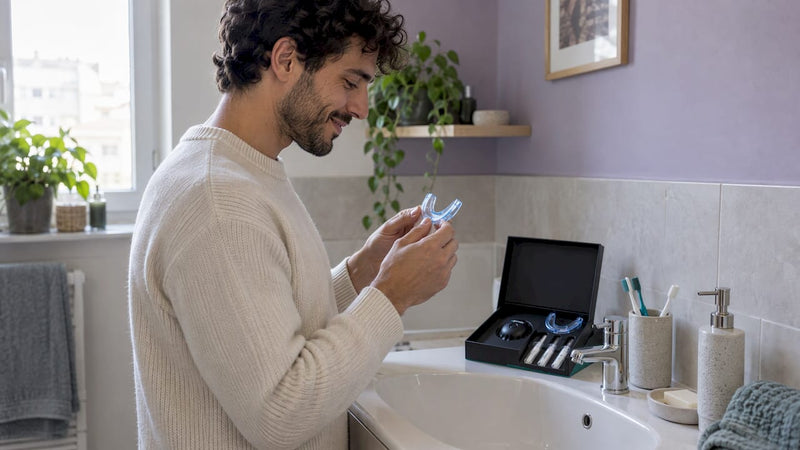
Whitening strips for teeth: a guide to whitening strips
Dental abrasive strips should never be used at home. If you are looking for a way to remove coffee, tea, wine, or smoke stains, the right product for you is a cosmetic whitening strip, not an abrasive clinical tool. The difference is not one of degree, but of category: using professional tools without dental supervision can cause irreversible damage to your enamel.
What to do instead:
- Choose cosmetic whitening strips with CPNP certification, which is mandatory for all cosmetics sold in Italy and the EU.
- Check the ingredients: hydrogen peroxide or carbamide peroxide for more effective action, or peroxide-free alternatives if you have sensitive teeth.
- Always follow the manufacturer's instructions and consult your dentist if you have cavities, restorations, or inflamed gums.
Esmile whitening strips are CPNP certified and available in Italy, designed specifically for those who want visible results at home safely.
A tip: Before starting any whitening treatment, check that there are no active cavities or gum problems: enamel that is already weakened reacts poorly even to the gentlest cosmetic products.
Table of Contents
- Why dental abrasive strips are not used at home
- How cosmetic whitening strips work
- How to choose safe whitening strips in Italy
- How to use whitening strips at home, step by step
- What to expect from whitening with strips
- Alternatives to strips and how to maintain results
- Key points
- Why the distinction between abrasive and whitening really matters
- Esmile whitening strips: CPNP certified, available in Italy today
- Sources and useful resources
Why dental abrasive strips are not used at home
Professional abrasive strips are clinical tools, not cosmetic products. Those made of steel with corundum abrasive (such as Diatech Coltene with a 50 µm grit) are used for interproximal enamel reduction and restoration finishing. Polyester versions, such as Kerr Dental's Hawe™, are designed to polish composite interproximal surfaces with different grits and a non-abrasive central window to protect contact points.
These products require precise control of angle and pressure, parameters that only a trained operator can manage. Using them on your own means risking:
- Irreversible enamel wear, which cannot be regenerated.
- Damage to the contact points between teeth, leading to plaque buildup.
- Gum injuries from direct abrasion on soft tissues.
- High costs to repair the damage with restorations or endodontic treatments.
Even the Pol-Intech strips for interdental spaces, although sold in packs of 25, explicitly state that they should only be used under dental supervision.
A tip: If a tooth feels "rough" or you notice an irregular edge on a restoration, do not try to file it down with any type of abrasive strip: book an appointment. What looks like a small defect could be a fracture or a filling margin that needs to be retouched.
How cosmetic whitening strips work
Whitening strips are thin strips coated with a peroxide-based gel that acts directly on the enamel. The gel usually contains hydrogen peroxide or carbamide peroxide, with application times typically ranging from 5 to 30 minutes depending on the concentration and product.
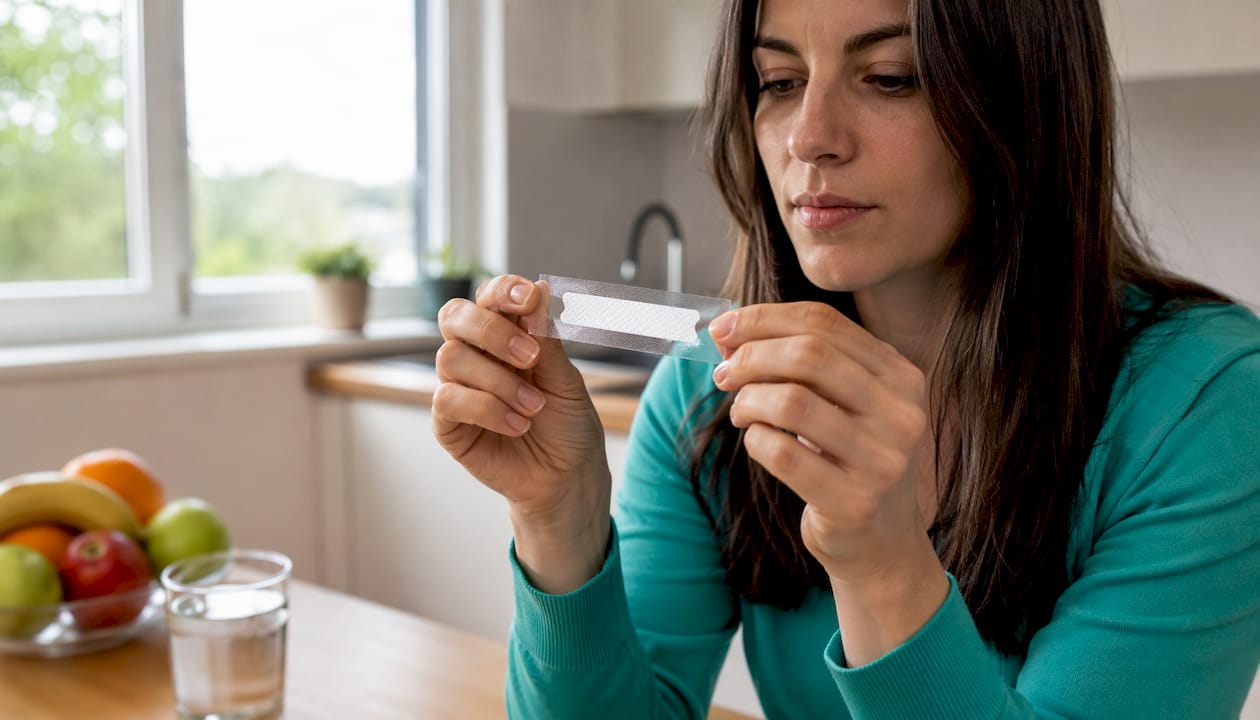
The mechanism is chemical: peroxides penetrate the superficial layer of the enamel and oxidize the color molecules responsible for stains, making them colorless. They work well on extrinsic stains, those caused by coffee, tea, red wine, and smoke. They have no effect on intrinsic discolorations (such as those caused by tetracycline) or on fillings, crowns, or veneers: restorations do not change color with peroxide.
Peroxide-free alternatives, such as activated charcoal, work by mechanically adsorbing color particles on the surface. They are often preferred by those with sensitive teeth, but their effectiveness on deeper stains is generally lower. This compromise should be considered before choosing.
Good to know: professional in-office treatments use peroxide concentrations up to the high concentrations used in professional in-office treatments, while at-home kits work with lower concentrations to reduce the risk of sensitivity.
How to choose safe whitening strips in Italy
Not all products on shelves or online meet the same standards. In Italy, a whitening cosmetic must be registered in the European Union's CPNP portal before being placed on the market. This registration certifies that the formulation has been notified to the competent authorities and complies with the concentration limits set by EU cosmetic regulations.
Practical checklist for choosing well:
- CPNP certification: check that the product is registered as an EU cosmetic, not as a medical device or supplement.
- Readable ingredients: the label must include the complete INCI list with the concentrations of active ingredients.
- Option for sensitive teeth: look for products with reduced concentrations or desensitizing agents such as potassium nitrate.
- Clear instructions: application times, frequency, and warnings must be indicated in Italian.
- Verified reviews: prefer products with feedback on certified platforms such as Amazon Italy, where comments are linked to actual purchases.
- Availability in Italy: buying from official channels reduces the risk of counterfeit or expired products.
Be wary of products without Italian labeling, without a batch number or expiration date, and those sold at prices much lower than the market average: they often do not comply with EU regulations.
How to use whitening strips at home, step by step
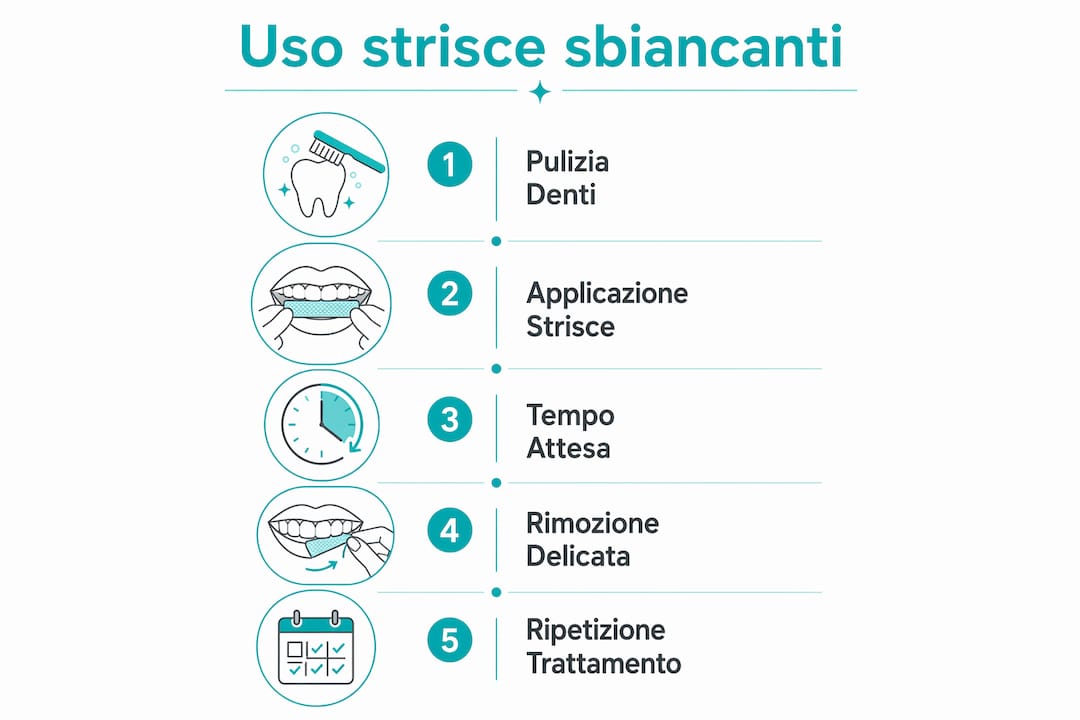
Following the correct procedure makes the difference between a satisfactory result and unnecessary irritation.
- Check teeth and gums. Do not start the treatment if you have untreated cavities, bleeding gums, or visible restorations in the front area.
- Brush teeth gently with a non-abrasive toothpaste, then dry the surface with a tissue or wait a few minutes: strips adhere better to dry enamel.
- Peel the strip from the backing and position it by aligning it with the gum line, with the gel side in contact with the teeth. Press lightly to make it adhere without pushing it onto the gums.
- Respect the time indicated by the manufacturer, usually between 5 and 30 minutes. Do not prolong exposure thinking you will get better results: it only increases the risk of sensitivity.
- Remove the strip and rinse thoroughly. Do not swallow the residual gel.
- In case of sensitivity or burning, stop the treatment, rinse with cold water, and use a toothpaste for sensitive teeth in the following hours. If the discomfort persists beyond 48 hours, consult your dentist.
Warning: whitening strips should never be applied to active cavities, inflamed gums, or visible composite restorations: peroxide can irritate the exposed dental pulp and does not work on restoration materials.
For a more detailed guide on how to whiten teeth without damage, Esmile has published specific resources on its website.
What to expect from whitening with strips
Results depend on the type of stains, the concentration of the gel, and consistency in treatment. Coffee and tea stains tend to respond well after just a few days of regular use. Red wine stains generally require a full cycle. Smoke stains, which are deeper and layered, may require repeated cycles or a complementary treatment.
Temporary sensitivity is the most common side effect: it manifests during or immediately after the treatment and disappears within 24–48 hours in most cases. Sensitive-teeth versions use lower concentrations or desensitizing agents to reduce this risk.
| Feature | CPNP cosmetic strips |
|---|---|
| Safety | EU-notified formulation; home use permitted |
| Effectiveness on coffee/tea/wine/smoke stains | Good for superficial extrinsic stains |
| Sensitivity incidence | Temporary; reduced in sensitive-teeth versions |
| Treatment duration | 14 days for a full cycle |
| Expected results | Visible after a few days; last for months with maintenance |
| Indicative price in Italy | Variable; available online and in pharmacies |
When results do not arrive after two full cycles, or if the stains are intrinsic in origin, it is time to consider a professional in-office treatment.
Alternatives to strips and how to maintain results
Strips are not the only option for at-home whitening. Kits with a mask and LED lamp, such as those offered by Esmile, combine a whitening gel with LED light to accelerate the action of the active ingredient. Whitening pens are practical for daily maintenance, especially after coffee or wine. Activated charcoal powders work by mechanical adsorption and are a frequent choice for those who prefer to avoid peroxides.
To prolong results over time:
- Use a whitening mouthwash with xylitol for daily maintenance.
- Reduce the consumption of colored beverages or rinse your mouth immediately after.
- Avoid treatments too close together: always respect the breaks between one cycle and the next indicated by the manufacturer.
- Never use professional abrasive tools at home, not even for "quick touches".
Do and don’t for storing strips:
- Store in a cool, dry place, away from direct light.
- Do not use expired strips: the gel loses effectiveness and can irritate tissues.
- Do not expose to high temperatures (e.g., in a car in summer): the gel degrades.
- Check the expiration date before each cycle.
A tip: A whitening mouthwash used in the evening, after brushing, can prolong the results of strips for weeks without adding sensitivity.
Key points
Dental abrasive strips are clinical tools: for safe at-home whitening in Italy, always choose cosmetic strips with CPNP certification and follow the manufacturer's instructions.
| Point | Details |
|---|---|
| Abrasive strips: clinical use only | Never use them at home: they damage enamel without professional supervision. |
| Mandatory CPNP certification | Always check that the product is registered as an EU cosmetic before purchasing it. |
| Peroxide vs. peroxide-free | Peroxide is more effective on deep stains; alternatives are indicated for sensitive teeth. |
| Sensitivity: temporary and manageable | Stop the treatment and use toothpaste for sensitive teeth if the discomfort persists beyond 48 hours. |
| Esmile: certified option in Italy | Esmile whitening strips are CPNP certified and available on Amazon Italy and in the official shop. |
Why the distinction between abrasive and whitening really matters
There is a understandable tendency to look online for "professional" solutions for teeth. The problem is that "professional" in the dental context does not mean "more effective for you": it means "designed for a trained operator, with control tools that you do not have at home". Clinical abrasive strips are the most direct example. Using them without knowing exactly where the contact point is, what grit is needed, and how much pressure to apply does not produce a better result: it produces damage.
At-home cosmetic whitening, on the other hand, is a field in which research has made concrete steps. CPNP certified products comply with concentration limits designed for the end consumer, not for the professional. Esmile was born precisely from this awareness: to offer products that work at home, with the transparency of EU certifications and instructions designed for those who are not dentists. Over 300 people a day choose Esmile products on Amazon Italy, and this figure tells something real about the trust that is built with clarity.
True safety does not lie in avoiding whitening: it lies in choosing the right product for the right context.
Esmile whitening strips: CPNP certified, available in Italy today
Those who have coffee, tea, wine, or smoke stains and want visible results without waiting for a dentist appointment find in Esmile whitening strips a concrete solution: 14 strips per cycle, CPNP certified, with a formula designed also for sensitive teeth. The kit includes clear instructions in Italian and can be combined with gel refills for the LED lamp for continuous maintenance.

For those who prefer a more complete approach, the professional whitening kit with LED technology combines gel and light to accelerate results. All products are available in the Esmile shop with express shipping in Italy. In case of doubts about the product most suitable for your situation, Esmile support is reachable directly from the website.
Note: Esmile products are certified cosmetics and do not replace the opinion of the dentist in the presence of dental or gum pathologies.
Sources and useful resources
To delve deeper into the topics covered in this guide, here are the main sources:
- Teeth whitening strips: how do they work and are they safe? — Dentavivo, in-depth look at ingredients and mechanism of action.
- At-home teeth whitening — Clinica DRM, comparison between at-home and professional treatments.
- Hawe™ finishing and polishing strips — Kerr Dental, technical data sheet on professional abrasive strips.
- Diatech Coltene abrasive strips — Esadental, example of corundum abrasive strips for clinical use.
- Pol-Intech abrasive strips — Edenta, interdental strips with a recommendation to consult a dentist.
- Esmile — teeth whitening products — complete range, CPNP certifications and brand information.
- Teeth whitening strips: do they really work? — Esmile Blog, efficacy and management of sensitivity.
For specific clinical questions (cavities, restorations, gums), your trusted dentist remains the point of reference. To check the CPNP registration of a cosmetic product, you can consult the European Commission's official portal dedicated to cosmetic products.
This guide is for general informational purposes and does not replace a professional dental evaluation. Always check the specific instructions of the product you intend to purchase.