Whitening spray: does it really lighten by one or two shades?
Teeth whitening spray works, but in a much more limited way than its name suggests. It slightly lightens the surface color of the teeth and helps maintain an already treated smile, but it cannot replace a professional peroxide-based protocol. If you have crowns, veneers, or active oral health issues, a dentist's assessment remains the first step before using any over-the-counter product. In the following sections, you will find the chemical mechanism, the real limitations, and safety guidelines.
In short:
- Whitening sprays work primarily through oxidation using low concentrations of peroxide, offering a superficial and very gradual effect.
- European regulations limit the peroxide levels in sprays, reducing their effectiveness compared to professional treatments with higher concentrations.
- If you want significant visible changes, it is important to manage your expectations and opt for products such as trays or professional appointments.
- The main side effects are temporary sensitivity and gum irritation, which are more likely with incorrect use or suboptimal oral health conditions.
- For lasting, visible results against deep stains, switching to professional treatment and consulting a dentist remains the most effective choice.
Table of Contents
- How teeth whitening spray works
- What you can really expect from whitening sprays
- Spray, pens, strips, or at-home kits: what to choose
- Safety and side effects to know before you start
- How to use whitening spray for the best results
- When spray is not enough: signs you should see a dentist
- Esmile's perspective on spray and DIY whitening
- The Esmile whitening kit: certified maintenance after spray
- Sources
How teeth whitening spray works
Most sprays on the market contain a combination of three types of active ingredients, each with a different function. Low-concentration peroxides (hydrogen or carbamide) work through oxidation: they penetrate the enamel and break the chemical bonds of the pigments responsible for stains, altering their molecular structure. This is the same principle used in professional treatments, but at much lower doses.
In addition to peroxides, many sprays use enzymes that help break down the plaque film where tea, coffee, and wine stains accumulate, and optical agents that do not chemically whiten anything: they only make the tooth appear visually brighter, much like how makeup concealer hides an imperfection without removing it.
Here is a comparison of the three mechanisms:
- Oxidation (peroxides): breaks down pigments in the enamel, producing a real but gradual effect.
- Enzymatic action: reduces the buildup of surface plaque, providing a preventive rather than whitening effect.
- Optical masking: alters the visual perception of color, producing an immediate but temporary effect.
Concentration matters more than the formula. European regulations on over-the-counter whitening products set a maximum peroxide limit much lower than that used in dental offices, and this inherently reduces the effectiveness of sprays sold outside the dentist's office. This is not a limitation of the product itself, but a regulatory choice designed to protect users who use it without clinical supervision.
What you can really expect from whitening sprays
The most common expectation—having "cover-model" teeth after just a few days of using spray—is also the main cause of disappointment. Confusion about effectiveness almost always stems from unrealistic expectations: a product designed for touch-ups is evaluated against the standards of a clinical treatment.
Whitening sprays and pens work better as daily "touch-up" tools than as a definitive solution: they are useful for a quick effect, but they cannot replace a high-concentration peroxide protocol or custom-made trays.
Several factors determine how much (and whether) you will notice a change. The type of stain is crucial: extrinsic stains caused by coffee, wine, or smoking and deposited on the surface of the enamel respond much better than intrinsic stains caused by medication or trauma, which are located deeper. Enamel thickness and porosity vary from person to person and influence how quickly the active ingredient works. Age also plays a role: over time, enamel naturally thins, revealing more of the underlying dentin, which is yellower.
A tip: evaluate the result in terms of shade, not "levels" of whiteness. A spray used consistently can lighten the surface by one or two perceived shades, but it will not turn deep yellow into dazzling white.
Those who use spray expecting this kind of incremental improvement are generally more satisfied than those who compare it to an in-office treatment.
Spray, pens, strips, or at-home kits: what to choose
Not all over-the-counter tools meet the same needs, and the right choice depends on what you want to achieve and how quickly.
- Spray: convenient for a quick touch-up before an event, it can be applied in a few seconds without water or rinsing, but its effect tends to be the most superficial among the over-the-counter options.
- Whitening pens: useful for correcting localized stains or refreshing the color between cycles, with precise application but coverage limited to a few teeth at a time.
- Whitening strips: provide prolonged contact with the active ingredient across the entire visible arch, resulting in a more even effect than spray, but requiring a longer application time.
- Whitening toothpastes: work primarily through controlled abrasion, useful for daily maintenance but with a minimal whitening effect if used alone.
- At-home kits with trays: combine peroxide with prolonged contact time, making them the most effective over-the-counter choice for those starting with a darker shade.
- Treatment from a dentist: remains the option with the highest peroxide concentrations and the fastest, most lasting results, recommended when a visible change is needed in just a few sessions.
If the goal is to maintain an already whitened smile or correct a minor post-coffee effect, spray does the job without complications. However, if you are starting with stains built up over years of smoking or drinking red wine, pens and strips cover the surface better, but only an at-home kit with trays or a professional appointment can produce a truly noticeable change. It is also worth being wary of the most popular home remedies: baking soda and activated charcoal have no solid evidence of whitening effectiveness, and charcoal, if used frequently, can be abrasive to the enamel.
Safety and side effects to know before you start
The most common side effects associated with whitening products, including spray, are temporary tooth sensitivity and gum irritation. Sensitivity manifests as an unpleasant reaction to cold or heat in the hours following application, while gum irritation occurs when the product comes into direct contact with soft tissues instead of the enamel. If the protocol is followed correctly, these effects generally remain mild and reversible.
Some situations require extra caution or complete avoidance of the product:
- Pregnancy and breastfeeding: due to insufficient safety data, many professionals recommend postponing any whitening treatment.
- Children and adolescents under 18: enamel is not yet fully mature, and sensitivity is higher.
- Active cavities or untreated gingivitis: peroxide can penetrate already compromised areas and worsen irritation.
- Teeth with visible restorations: the effect will be uneven between natural teeth and artificial materials.
A tip: stop using the product at the first sign of persistent pain or gum swelling, and do not increase the frequency of application thinking you will speed up the results: the risk of irritation grows faster than the whitening effect.
How to use whitening spray for the best results
Preparation is almost as important as the product itself. Enamel clean of plaque and tartar responds better to any whitening agent, and a professional cleaning before starting the cycle also reduces the risk of irritation during use.
- Before the cycle: consider a professional hygiene appointment, especially if you have not had one in over six months.
- Application: spray directly onto the teeth, avoiding contact with the gums, and follow the frequency indicated on the packaging, generally once or twice a day.
- Application time: leave the product on without rinsing for the indicated time, and avoid eating or drinking immediately afterward so as not to dilute the effect.
- Maintenance: incorporate a whitening toothpaste into your daily routine and consider a temporary "white diet," limiting coffee, red wine, and cigarettes for the first 48 hours after each intensive application.
- Refresher treatments: repeat the cycle with spray or pens every two or three weeks to maintain the results over time, especially if you regularly consume color-producing beverages.
Those who have already undergone professional treatment find spray to be a cost-effective way to prolong the results rather than a starting point.
When spray is not enough: signs you should see a dentist
Some situations are beyond the reach of any over-the-counter product, and recognizing them early helps avoid unnecessary expenses and frustration.
- Crowns, veneers, and visible fillings: these materials do not react to peroxides like natural enamel, so they retain their color while the surrounding teeth whiten, creating a patchy effect.
- Tetracycline or trauma stains: these are intrinsic stains located in the dentin and often require prolonged professional protocols or aesthetic solutions such as veneers.
- Persistent pain during use: if sensitivity does not subside between applications, it is time to stop and see a dentist.
In these cases, the dentist may recommend a higher-concentration protocol or a restorative treatment, with timelines and expectations very different from those of an over-the-counter spray.
Esmile's perspective on spray and DIY whitening

The company only works with CPNP-certified products, making safety the foundation of every formula. A significant number of people regularly choose the kits, responsibly being honest about the real limitations of sprays, not just their strengths.
We do not believe that a spray can replace professional treatment, and we say so even when it is not convenient to do so. However, we believe that when used with realistic expectations and as part of a careful hygiene protocol, it remains a valid tool for daily maintenance. Before starting any cycle, a dentist's assessment remains a step that no over-the-counter product can replace.
— Esmile
The Esmile whitening kit: certified maintenance after spray
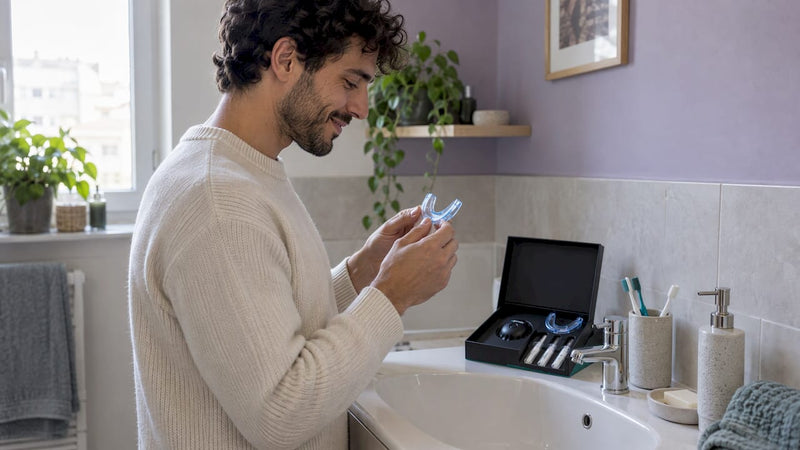
If you need spray for a quick touch-up, the next step for more visible and lasting results is a complete cycle using LED technology, designed for those who want to address coffee, wine, or smoking stains without having to visit the dentist every time.

Esmile's professional teeth whitening kit is CPNP-certified and formulated for those with sensitive teeth as well, featuring a purple gel that works in synergy with LED light to intensify the whitening effect compared to spray used alone. It is designed for use in cycles, not daily, so it integrates well with maintenance products such as V34 purple strips between treatments.
It is not the solution for crowns or veneers, and it does not remove deep intrinsic stains: for that, a dentist is still necessary. But for those seeking a real step up from spray without the cost of repeated in-office appointments, it is the logical next step. Visit the whitening kit page to see availability and purchase details.

Sources
To check the compliance of a whitening product sold online, the Italian Ministry of Health's electronic commerce register is a reliable institutional resource. The sources cited in this article come from Italian dental studies and clinical publications, chosen for their direct relevance to the mechanisms and safety of over-the-counter whitening.
This article provides general information and does not replace the advice of a qualified medical professional. Consult a qualified healthcare professional regarding your specific case before acting on this content.
- Teeth whitening: Which technique really works? The complete guide
- Professional teeth whitening vs. at-home kits
- Teeth whitening: a complete guide to how it works, how long it lasts, and when it is truly effective
- Natural white teeth: how to achieve them