

Whitening and enamel: how to protect your teeth while brightening your smile
Teeth whitening, when performed according to the instructions, rarely causes permanent damage to the enamel: the real risk depends on the concentration of the active agent and the exposure time, not on the technique itself. The most commonly used active ingredients are hydrogen peroxide, carbamide peroxide, and PAP, and the dentist remains the point of reference for correct dosages. If you notice severe pain, bleeding gums, or dark spots that do not lighten, stop and consult a professional.
In short:
- The risk of permanent damage to the enamel depends on the concentration of the whitening agent and the exposure time, not on the technique used.
- The concentrations of hydrogen peroxide and carbamide often used can cause minimal surface microhardness without clinical implications if the correct methods are followed.
- LED light has a marginal effect on whitening efficacy and can temporarily increase tooth sensitivity, even with lower peroxide concentrations.
- Prolonged whitening or use of high concentrations increases the risk of sensitivity and microlesions, but real damage to the enamel is avoided with treatments that respect time and quantity limits.
- CPNP-certified products and dental consultations before use are essential to ensure safety and optimal results, especially in the presence of particular conditions such as cavities or gingivitis.
Table of Contents
- How teeth whitening works: mechanisms and active agents
- Scientific evidence on the effect of whitening on enamel
- Types of teeth whitening and risk to enamel: practical comparison
- When not to whiten your teeth: contraindications and warning signs
- How to whiten your teeth without damaging the enamel: practical protocol
- Enamel care after whitening: what to do to maintain the result
- Why CPNP certification matters when choosing a product for enamel
- A certified at-home kit for those who want results without going to the dentist
- The balance between aesthetics and enamel safety
- Sources
- Frequently asked questions
How teeth whitening works: mechanisms and active agents
Tooth enamel and whitening are linked by a precise chemical reaction: oxidizing molecules penetrate the porous structure of the tooth and break down the pigments responsible for stains. Hydrogen peroxide breaks down into water and free radicals that attack chromophores, the colored molecules accumulated in the enamel and the underlying dentin. Carbamide peroxide works in a similar way, but releases it more slowly because it first breaks down into hydrogen peroxide and urea, which is why it is often used in overnight kits.
PAP (phthalimidoperoxycaproic acid) represents the most recent alternative. It does not contain peroxide directly and acts with a gentler oxidative mechanism, designed for those who have sensitive enamel or a history of gum irritation with traditional products.
It is important to distinguish between two types of stains, because they do not respond in the same way:
- Extrinsic stains: deposited on the surface by coffee, wine, tea, smoking, or plaque, and respond well and quickly to bleaching.
- Intrinsic stains: formed inside the dentin due to genetics, medications (such as tetracycline), or trauma, and require longer treatments with often partial results.
LED light, often sold as an essential accelerator, has a more marginal role than marketing suggests. An umbrella review from 2026 indicates with moderate certainty that light does not substantially improve the efficacy of the treatment and may even increase tooth sensitivity, while low or medium concentrations of peroxide (about 25-35%) achieve results comparable to higher ones with fewer side effects.
Scientific evidence on the effect of whitening on enamel
The question that worries those considering a treatment the most is whether the enamel really thins. A meta-analysis published in 2026 measured statistically detectable reductions in enamel microhardness after bleaching, but the extent of these changes appears small and generally clinically insignificant when protocols are followed.
Changes measured in the laboratory do not automatically equate to clinical damage: a minimal reduction in microhardness does not in itself imply an increased risk of cavities or a perceptible loss of enamel, as long as the indicated usage protocol is followed.
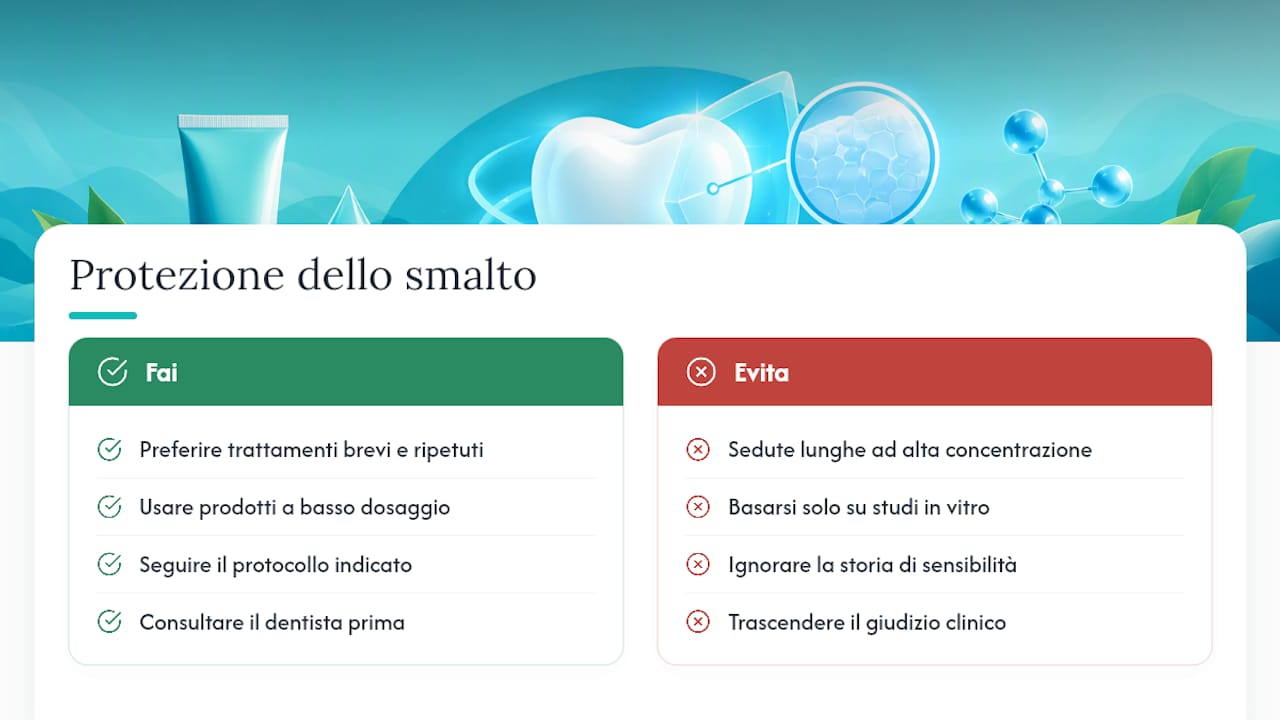
The factor that weighs more than any other is exposure time, followed by the concentration of the active agent. Short and repeated treatments with low-dosage products tend to produce less stress on the tooth surface compared to long sessions with high concentrations, even when the final result in terms of color is similar.
It is worth reading this data with a critical filter. Many of the studies underlying the reviews are conducted in vitro, on extracted teeth immersed in solutions for times that do not faithfully replicate real use, with saliva, natural remineralization, and individual variability. The clinical judgment of the professional who follows you counts more than any isolated laboratory value, because it takes into account the starting enamel, history of sensitivity, and dietary habits.
The ADA guidelines confirm that the most common side effect remains temporary sensitivity, not permanent structural damage, and that over-the-counter products contain lower peroxide concentrations than those used in the office.
Types of teeth whitening and risk to enamel: practical comparison
Not all techniques put the enamel under the same stress, and the difference lies mainly in the concentration applied and the supervision received.
- Professional in-office whitening: uses the highest peroxide concentrations, applied under the dentist's direct control with gum protection; rapid results but a higher risk of sensitivity in the following hours.
- Dentist-prescribed kits for at-home use: custom trays and intermediate concentrations, with an effective compromise between results and safety thanks to periodic monitoring.
- OTC products and whitening strips: lower concentrations, designed for independent use, suitable for mild extrinsic stains but with longer times to results.
- Do-it-yourself home remedies: lemon, baking soda, or improvised acid mixtures are not formulated for oral use and should be avoided.
On this last point, the literature is clear: a study published on F1000Research found that abrasives such as baking soda and charcoal can increase surface roughness and reduce enamel microhardness in laboratory tests, especially with whitening toothpastes used aggressively or too frequently. Mechanical abrasion erodes the enamel in a different way and is harder to recover compared to the controlled chemical action of a correctly dosed oxidizing agent.
When not to whiten your teeth: contraindications and warning signs
Some conditions require stopping before starting, others require immediately interrupting the ongoing treatment.
- Enamel erosion or active cavities: the whitening agent penetrates more easily where the structure is already compromised, increasing pain and the risk of damage to the dentin.
- Active gingivitis or periodontitis: inflamed tissues absorb peroxide irregularly and gum sensitivity worsens rapidly.
- Minors, pregnancy, and breastfeeding: the NHS advises against the treatment under 18 years of age and recommends caution during pregnancy due to insufficient data on safety.
- Extensive restorations, crowns, or veneers: external bleaching only acts on natural teeth, not on prosthetic materials, with the risk of an uneven color in the smile.
During treatment, acute and persistent pain, bleeding gums, or isolated dark spots that do not react are signs that require a dental evaluation before continuing.
How to whiten your teeth without damaging the enamel: practical protocol
The first step, before opening any kit, is an honest assessment of your own mouth: already sensitive teeth, untreated cavities, or inflamed gums completely change the recommended approach. A dental consultation, even a brief one, allows you to rule out conditions that would make the treatment counterproductive.
Once the product is chosen, the most important rule is to follow the times and frequency indicated on the label without modifying them on your own initiative. Increasing the application time or repeating the treatment more often than recommended does not speed up the results, it only increases the risk of sensitivity and superficial microlesions.
A tip: if you notice tingling in your teeth during the first applications, reduce the frequency to every other day instead of stopping completely: often this is enough to acclimate the enamel without giving up the result.
To choose a safe product, some checks make a difference:
- Check that the product bears the CPNP certification, mandatory for cosmetics sold in Europe.
- Check that the retailer is reliable and not an untraceable channel, as also advised by the NHS guidelines on the risks of treatments performed by unqualified personnel.
- Read the concentration of the active agent indicated on the label and compare it with the intended use (occasional or daily).
- Choose formulas designed for sensitive teeth if you have already had episodes of discomfort with other products.
To navigate through the many available options, a guide on how to choose a safe whitening kit helps to compare formulations and concentrations before purchase. If you suffer from bruxism, it is worth also looking into how this affects the safety of the treatment, because nighttime pressure on the teeth can increase post-treatment sensitivity.
Enamel care after whitening: what to do to maintain the result
In the 24-48 hours following the treatment, the enamel is temporarily more permeable and absorbs pigments more easily. Avoiding coffee, red wine, black tea, and cigarettes in this window makes a real difference in the longevity of the obtained color.
For daily maintenance, three habits count more than all others:
- Use low-abrasivity toothpastes, avoiding those with large particles of charcoal or excess baking soda.
- Choose fluoride formulas, which promote the remineralization of the enamel after the oxidative stress of the treatment.
- Schedule a periodic touch-up instead of close-together intensive cycles, so you maintain the result without overexposing the tooth.
According to the NHS, the results of a well-performed whitening can last up to about three years with proper care, even if individual variability remains high based on diet and habits such as smoking or coffee consumption. It is worth scheduling touch-ups based on real signs of yellowing rather than a fixed calendar: a guide on the correct frequency of whitening helps to understand when it is the right time for a new cycle. If you also plan a professional cleaning, doing it before the treatment improves the uniformity of the result, as explained in a guide dedicated to pre-whitening cleaning.
Why CPNP certification matters when choosing a product for enamel
CPNP certification certifies that a cosmetic respects European safety standards in terms of ingredients and notifies the competent authorities, but it does not equate to a clinical guarantee of suitability for every mouth. Those who have active cavities, gingivitis, or enamel erosion must still read the label and warnings carefully and, in case of doubt, ask confirmation from their dentist before use.
Some teeth whitening kits are CPNP-certified and formulated also for those who have sensitive teeth, a detail to consider when choosing between dozens of similar products online. The certification remains a starting point, not a substitute for the personal assessment of your own oral health.
A certified at-home kit for those who want results without going to the dentist
If you have read this far, you have probably already understood that the real dividing line is not “whitening yes or no”, but which product and which concentration to choose based on your situation. There are ranges designed for at-home use that include kits with LED technology, peroxide-free whitening strips, active charcoal powder and purple gel, many with CPNP certification and formulated also for those who have sensitive teeth.

A home kit like the one offered by Esmile is the right choice when stains are mainly extrinsic, caused by coffee, tea, wine, or smoking, and there are no conditions such as active cavities or ongoing gingivitis. If, however, you recognize any of the warning signs described in this article, the right step is still to consult a dentist before proceeding. For those who want to start with a complete treatment, the collection of whitening kits allows you to compare formulas and accessories, including gel refills for those who want to maintain the results over time without purchasing a complete kit every time. Those who prefer a faster option to integrate into their routine can consider whitening strips as a practical alternative to longer treatments.
The balance between aesthetics and enamel safety
The debate on tooth enamel and whitening is often oversimplified, as if the choice were between “risky” and “harmless.” The reality, as emerges from the most recent reviews, is more nuanced: actual damage depends on controllable variables, concentration, and exposure time, not simply on whether or not you whiten. Those who sell or recommend whitening products have a responsibility to communicate this clearly, without downplaying sensitivity or exaggerating risks to sell an alternative service. The safest choice remains to stay informed, read the labels, and not be afraid to ask for professional advice when something doesn’t seem right.
— Esmile
This article provides general information and does not replace the advice of a qualified medical professional. Consult a qualified healthcare professional regarding your specific case before acting based on this content.
Sources
- Umbrella review (2026) on peroxide concentrations and the role of LED light
- Enamel damage from tooth-whitening — systematic review and meta-analysis (2026)
- Effect of whitening toothpaste on surface roughness and microhardness (F1000Research, 2022)
- Whitening | American Dental Association
- Teeth whitening — NHS
Frequently Asked Questions
Does teeth whitening ruin enamel?
In most cases, no, if the treatment follows the indicated concentration and duration instructions. The most recent reviews show small reductions in enamel microhardness, generally without clinical significance when protocols are followed.
How to whiten teeth without ruining enamel?
Choose CPNP-certified products with concentrations suitable for your type of teeth, avoid increasing the time and frequency beyond what is stated on the label, and protect the enamel after treatment with low-abrasion fluoride toothpastes. Consulting a dentist before starting reduces the risk of adverse reactions.
What can't you do after teeth whitening?
Avoid coffee, tea, red wine, and smoking for the next 24-48 hours, because the enamel is temporarily more permeable to pigments. Also avoid highly abrasive or charcoal-based toothpastes during this phase, so as not to further stress the tooth surface.
When can't teeth whitening be done?
It is not recommended in the presence of active cavities, gingivitis, enamel erosion, or extensive restorations such as crowns and veneers, which do not react to the treatment. The NHS also advises against the treatment for minors and recommends caution during pregnancy and breastfeeding.
How much do Esmile whitening kits cost?
Prices vary depending on the product chosen, from complete kits to whitening strips and gel refills, and are indicated directly on their respective pages on the Esmile website.


