

Teeth whitening for an interview: how to whiten your teeth safely at home
For an interview in one to two weeks, the most reliable method remains a single, consistent home protocol, followed without deviation: strips, PAP gel, or LED kits, never combined. The Cochrane review confirms a real improvement compared to the placebo, albeit with still limited evidence, and tooth sensitivity remains the most frequent side effect to monitor.
In short:
- LED kits do not demonstrate a substantial increase in efficacy compared to gel alone, but are recommended for short and practical routines.
- Whitening strips are more practical and less irritating, ideal for urgent periods, but offer more gradual results.
- With less than a week, a short and targeted treatment is preferable, as quick results tend not to last over time.
- Tooth sensitivity is the main side effect of treatments and increases with higher concentrations of peroxides.
- It is essential to follow safety rules such as avoiding coffee, wine, and cigarettes in the 48 hours before the appointment.
Index
- Whitening for an interview: which home methods really work
- When to start to have whiter teeth at the interview
- Safety, sensitivity and European rules to know before starting
- How to apply the treatment safely before the interview
- What to avoid in the 48 hours before the appointment
- What field experience with home whitening teaches us
- Where to find the right products to prepare for the interview
- Sources
- Frequently asked questions
Whitening for an interview: which home methods really work
Each home format has a different compromise between speed, convenience, and intensity of results. Understanding the differences prevents buying three products when one used properly would suffice.
- LED kits: the light accelerates the activation of the gel applied with the trays, but the literature does not show that it substantially increases long-term efficacy compared to gel used alone. It is especially suitable for those who want a short routine repeatable every evening.
- Whitening strips: practical, quick to apply, ideal for those who have little time or travel often. The result tends to be more gradual compared to concentrated gels, but the risk of gum irritation is generally lower.
- Gels and pens, including PAP formulas: peroxide-free formulations such as PAP show interesting results in vitro, with fewer alterations to the tooth surface, but the clinical evidence remains limited and does not always translate into a stable effect over time.
- Activated charcoal and whitening toothpastes: they act mainly on the surface, useful for removing light stains from coffee or tea, but little effective on deep or intrinsic stains.
When to start to have whiter teeth at the interview
The time available determines which method to choose and how much to realistically expect.
- With three or four weeks in advance: you can follow a complete protocol with gel or strips every other day, assessing the results week after week and stopping if persistent sensitivity appears.
- With two weeks: a cycle of strips or low-dose gel, applied daily according to the instructions, often produces a visible but moderate improvement.
- With one week: better a short and targeted treatment, without intensifying the doses to “make up time”: a study on laser-activated PAP showed an immediate improvement, but the color returned to starting levels after three months, a sign that quick results are not always stable.
- With less than seven days: aim for professional hygiene, whitening toothpaste, and small aesthetic adjustments rather than an aggressive cycle.
Do not combine two protocols in the same week: it does not increase efficacy and only complicates the management of any unwanted effects.
Safety, sensitivity and European rules to know before starting
Tooth sensitivity is the most common side effect of any chemical whitening, and it is consistently documented in scientific reviews on the subject.
A meta-analysis of dozens of studies shows that higher concentrations of carbamide peroxide (20-22%) and hydrogen peroxide (14-16%) increase the risk and intensity of sensitivity compared to more diluted formulas, although the quality of the evidence remains low.
European regulations set a clear boundary: cosmetic products with hydrogen peroxide between 0.1% and 6% can be sold to the public, but for the first use of a cycle, dentist supervision is required. Beyond this threshold, the product is not intended for home use.
PAP formulas, without peroxide, were created precisely to bypass this regulatory limit with a lower perceived risk profile. They remain, however, a relatively young technology: the “peroxide-free” promise does not automatically equate to greater safety or duration, it must be evaluated together with the actual concentration and the protocol of use.
Before buying, always check:
- The exact percentage of the active ingredient indicated on the label, as required by the European cosmetics regulation.
- The presence of indications for sensitive teeth or irritated gums.
- The maximum application times recommended by the manufacturer.
How to apply the treatment safely before the interview
A well-executed protocol counts more than the technology declared on the packaging. Here are the steps to follow in order.
- Check the condition of the teeth: verify the absence of visible cavities, exposed fillings, or existing sensitivity. In case of doubt, consult a dentist first.
- Do a thorough cleaning: brush your teeth with normal toothpaste and use dental floss the evening before starting, to remove plaque and residues that would reduce the product's efficacy.
- Choose a single protocol: strips, gel with tray, or LED kit, following exactly the application times indicated on the packaging, without extending them to “speed up” the result.
- Apply consistently: most products require daily or every-other-day application for one or two weeks; skipping days only extends the times.
- Monitor your mouth every day: stop or reduce the frequency if you notice sensitivity to cold, prolonged tingling, or reddened gums.
- In the following days: maintain the result with a whitening toothpaste and, if necessary, a light touch-up with a gel pen, without repeating the entire cycle close to the interview.
A tip: if sensitivity appears in the first few days, do not stop abruptly: reduce the application frequency to every other day and consider a specific toothpaste for sensitive teeth before resuming the full protocol.
The internal guides on how to whiten teeth at home without ruining them and on whitening for sensitive teeth go into more detail if you already start with a delicate mouth.
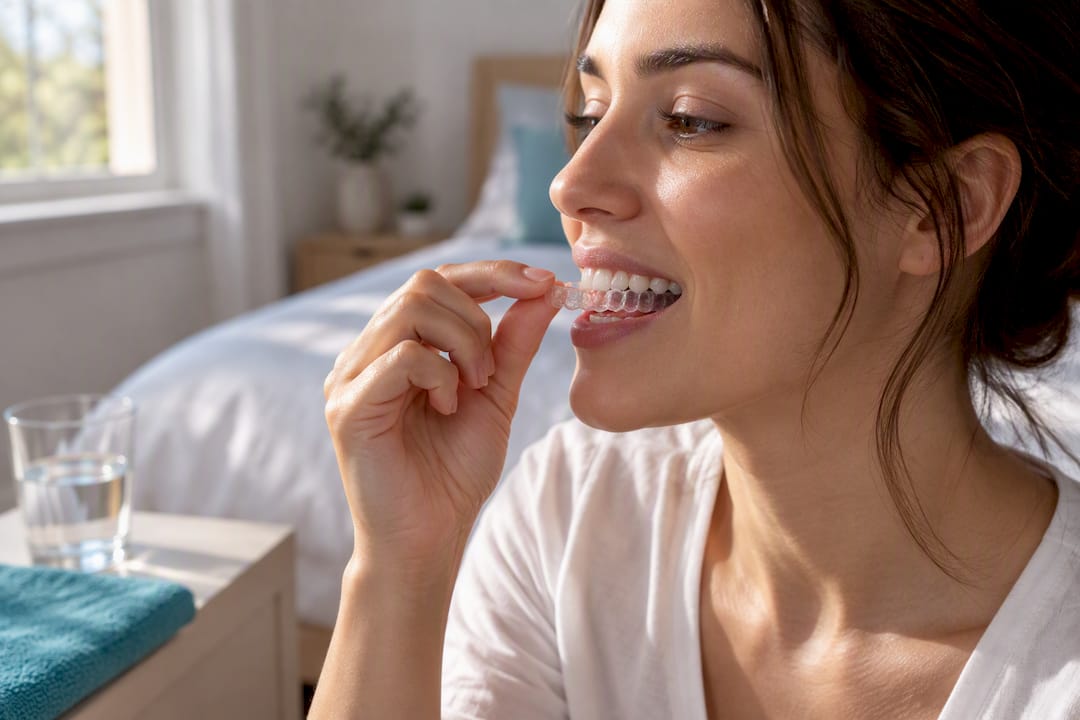
What to avoid in the 48 hours before the appointment
In the last hours before the interview, the result is defended more with renunciations than with new treatments.
- Avoid coffee, black tea, red wine, and cigarettes: they are the main sources of immediate surface stains.
- Limit dark sauces, curry, and colored carbonated drinks, which can settle on the newly whitened enamel.
- Use a whitening toothpaste on the morning of the interview to refine the effect without stressing the teeth.
- Apply a lipstick or lip gloss with cool undertones: it contrasts the residual yellow and makes the smile appear brighter.
- If you have a corrective pen, use it only on the most visible spots, without repeating the entire treatment.
To understand how long the effect will last after the interview, the guide on how long whitening lasts and how to maintain it explains what to expect in the following weeks.
What field experience with home whitening teaches us
Since 2021, CPNP-certified whitening kits have been on the market, developed with attention to available clinical evidence, not just current trends. The collaboration with figures such as Dr. Marilena Troise has strengthened the attention towards sensitive teeth, a topic that in daily practice weighs more than advertising labels suggest. Those who suffer from bruxism find more specific indications in the dedicated guide on whitening and bruxism.
— Esmile
Where to find the right products to prepare for the interview
A CPNP-certified whitening kit at home can cost less than an in-office treatment and produce a visible improvement within one or two weeks, without appointments to book.

The main collection of whitening kits covers the needs of those starting from scratch, while the whitening strips remain the most convenient option for those who have a week or less before the appointment. Those who have already done a full cycle and just want to maintain the result find in the gel refills the most economical solution to not start over. All products are CPNP-certified and covered by a 30-day money-back guarantee, a useful margin for those who want to try without risks before an important event. If you already have the days counted, choose now the kit or the strips most suitable for your available time and start the protocol tonight itself.
This article provides general information and does not replace the opinion of a qualified medical professional. Consult a qualified healthcare professional regarding your specific case before acting based on this content.
Sources
- Home-based chemically-induced whitening (bleaching) of teeth in adults — Cochrane
- Laser-assisted PAP bleaching — PMC
- Network meta-analysis on tooth sensitivity and concentrations — PubMed
- EU regulation on cosmetics and peroxide concentration
Frequently asked questions
How long before an interview do you need for whiter teeth?
With one or two weeks in advance, most protocols with strips or gel produce a visible improvement. With less than seven days, it is better to aim for a short treatment and small aesthetic adjustments, avoiding more aggressive doses to “make up time”.
Does whitening hurt sensitive teeth?
Sensitivity is the most common side effect, documented in scientific reviews on the subject, but it is generally temporary and manageable by reducing the application frequency. Those who already start with sensitive teeth should choose formulas designed specifically for this problem.
Are LED kits more effective than strips?
There is no solid evidence that LED light substantially increases efficacy compared to gel used alone; consistency in application counts more than the declared technology. Strips remain a practical and equivalent choice for many users.
What should I avoid in the days before the interview?
Coffee, black tea, red wine, and cigarettes are the main sources of immediate surface stains. In the 48 hours preceding, it is also advisable to limit dark sauces and colored carbonated drinks.
How much do Esmile whitening kits cost?
Prices vary based on the product type and are indicated directly on the pages of each Esmile collection. All kits are CPNP-certified and covered by a 30-day money-back guarantee.


