Whitening and cavities: when it’s safe and when to wait
If you have active decay, it is not the time to whiten your teeth. The whitening gel can penetrate the lesion, reach the exposed dentin, and cause acute pain or irritation of the dental pulp. The correct sequence is always the same: first treat the decay with your dentist, then consider whitening on healthy, clean teeth.
In short:
- Teeth whitening should not be performed on teeth with active decay, because the gel can penetrate the lesion and cause pain or pulp irritation.
- Before whitening, a complete dental check-up is necessary to ensure the absence of decay, inflammation, or deteriorated restorations, to guarantee the safety of the treatment.
- Fillings and ceramic or composite crowns do not change color during whitening, so they may need to be replaced to even out the color of your smile.
- Tooth sensitivity and gum irritation are common temporary side effects, but prolonged worsening requires an immediate check-up with the dentist.
- The correct sequence involves treating decay, having a professional cleaning, and then proceeding with whitening, always following a dentist's instructions.
Table of Contents
- Why whitening and decay don't go together
- The check-up that precedes every safe whitening
- Fillings, crowns, and root-canal-treated teeth: what to expect
- Sensitivity and gum irritation: what to do when they appear
- Treat decay and then whiten: the correct step-by-step sequence
- Why institutional sources and clinical evaluation matter
- Safety before aesthetics: what really matters
- Maintaining your smile after professional care
- Sources
- Frequently Asked Questions
Why whitening and decay don't go together
Whitening gels based on hydrogen peroxide or carbamide work by penetrating the enamel to reach the pigments responsible for discoloration. On a healthy tooth, this process is controlled: intact enamel limits how much gel reaches the underlying dentin and nerves. Decay breaks this barrier.
Where there is a cavity, the gel finds a direct path to the exposed dentin and, in more advanced cases, to the dental pulp. Decay is a multifactorial disease that requires clinical and often radiographic diagnosis, and it is precisely this variability that makes a decayed tooth's reaction to contact with whitening agents unpredictable. The main risk is acute hypersensitivity, sometimes accompanied by throbbing pain that can last for days.
Some clinical signs increase the level of caution:
- Deep decay lesion, visible or detected via X-ray.
- Dentin exposed to touch or air, often perceived as a sudden twinge.
- Spontaneous pain, not caused by external stimuli such as cold or sweets.
- Presence of old fillings with chipped or infiltrated margins.
There is no universal numerical threshold that says "this decay is too small to be a problem". Even an initial lesion, if left untreated, can become the gateway for the whitening gel during treatment. For this reason, the evaluation must be done case by case, with a direct check-up in the office, not by eye in front of the mirror at home.
A tip: if in recent months you have noticed localized sensitivity on a specific tooth, that is not a coincidence to be ignored: have it checked before purchasing any whitening product.
The check-up that precedes every safe whitening
Before any whitening treatment, professional or at-home, a check-up is needed to verify the actual state of the mouth. It is not a formality: it is the step that distinguishes a safe whitening from an improvised one.
The evaluation process generally follows these steps:
- Medical history: the dentist gathers information on past sensitivity, allergies to peroxides, current pregnancy or breastfeeding, and the presence of orthodontic appliances.
- Visual clinical examination: check of every tooth, the gums, and existing restorations to identify decay, inflammation, or defective margins.
- X-rays, when necessary, to identify lesions not visible to the naked eye, especially between teeth or under old fillings.
- Oral hygiene assessment: residual plaque and tartar alter the uniformity of the final color and must be removed before starting.
- Professional cleaning, which cleans the tooth surface and allows the correct starting shade to be chosen for comparison at the end of the treatment.
Before whitening, it is necessary to treat decay, gingivitis, and tartar: these conditions affect both the safety and the aesthetic outcome. A cleaning session, in addition to preparing the tooth, allows the dentist to correctly evaluate the reference color against which to measure progress.
For those with sensitive enamel or who have already suffered discomfort after whitening treatments, many protocols involve the use of calcium-based mousses or topical fluoride applications in the preceding weeks, to strengthen the enamel and reduce the risk of pain during treatment.
A tip: always ask your dentist for a written map of the areas to monitor during whitening, especially if you have more than one restoration in your mouth: it helps to distinguish normal sensitivity from a warning sign.
Fillings, crowns, and root-canal-treated teeth: what to expect
Peroxide acts on the natural tissues of the tooth, not on artificial materials. Whitening does not change the color of crowns, veneers, or fillings: they will remain exactly the shade they were made in, while the rest of the tooth lightens.
This creates some practical consequences to consider before starting:
- A visible filling on a front tooth may appear darker or lighter than the whitened tooth around it, creating an obvious color patch.
- Ceramic or composite crowns remain unchanged: if they cover teeth that will be whitened, the color misalignment becomes visible over time.
- In some cases, after whitening, it is advisable to replace the restoration with one in a shade consistent with the new natural color, for a uniform effect.
For root-canal-treated teeth, the situation is different. No longer having pulp, these teeth can also be whitened from the inside: the gel is placed directly in the pulp chamber, in a procedure called internal whitening. It is an effective technique but less predictable than that on vital teeth, and often requires more sessions to achieve a stable result. The dentist evaluates case by case how long it will take and if the obtainable color will be uniform with the neighboring teeth.
The practical rule remains simple: plan the whitening taking into account every visible restoration in your smile, not just the natural teeth you want to whiten.
Sensitivity and gum irritation: what to do when they appear
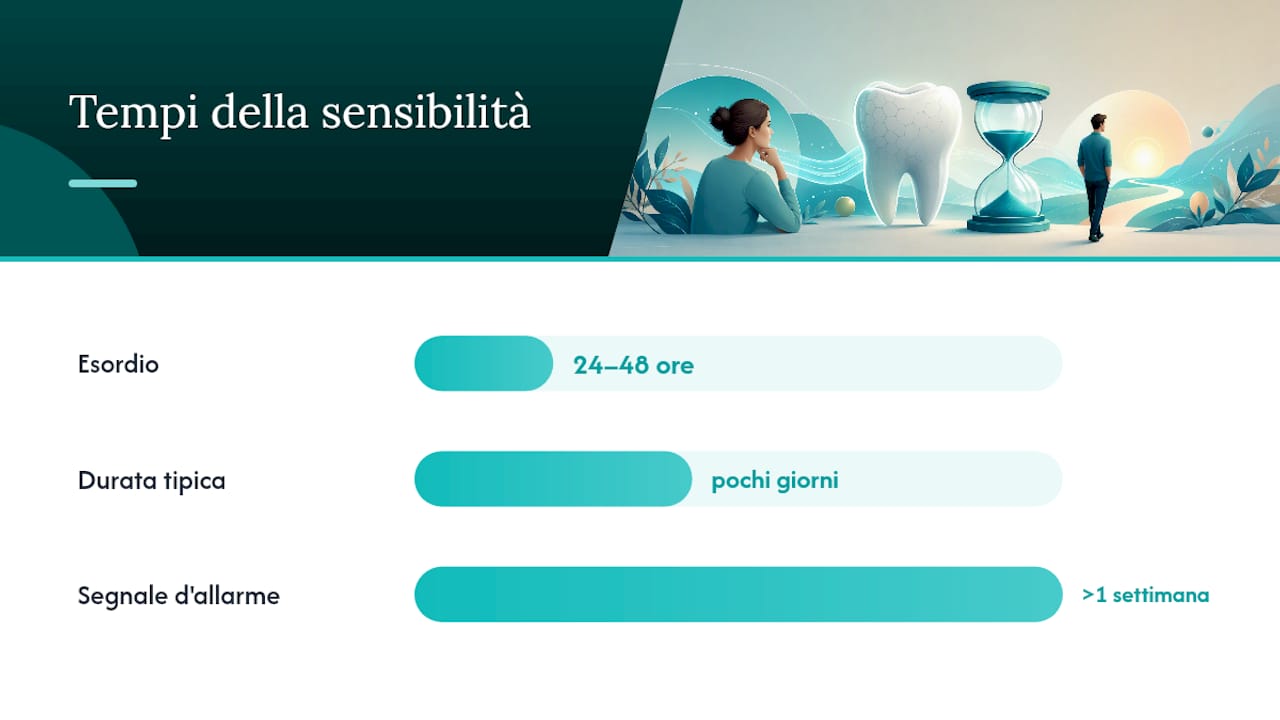
Tooth sensitivity is the most common side effect after whitening, even when the mouth is healthy. It generally appears in the first 24-48 hours and tends to decrease on its own within a few days. Professional whitening performed after clinical evaluation is considered safe: the most frequent effects remain temporary sensitivity and mild gum irritation, not permanent damage.
Gum irritation, on the other hand, almost always stems from prolonged contact of the gel with soft tissues, often due to a poorly fitted tray or imprecise application of DIY products.
Some strategies concretely reduce these discomforts:
- Use potassium nitrate-based desensitizing toothpastes or gels in the days before and after treatment.
- Choose neutral pH products, less aggressive on enamel already exposed to whitening agents.
- Insert one-day breaks between applications if sensitivity increases, instead of forcing the protocol.
- Apply fluoride-based creams to the most sensitive areas, following the dentist's instructions.
A tip: if sensitivity lasts more than a week or if throbbing pain appears, do not wait for it to pass on its own: it is the sign that something, such as an undetected micro-decay, deserves a direct check-up.
Treat decay and then whiten: the correct step-by-step sequence
The safest path follows a precise order, and skipping a step only increases the risk of having to start all over again.
- Treat deep decay first of all. No aesthetic treatment should start on a tooth with an active lesion.
- Respect the waiting times after a restoration. Restoration materials, such as composite resins, need a few weeks to fully stabilize before being exposed to the whitening gel.
- Book a professional cleaning. It removes plaque and tartar and prepares the tooth surface to react uniformly to the treatment.
- Proceed with whitening, chosen together with the dentist based on the state of the enamel and individual sensitivity.
Not all lesions require postponing whitening indefinitely. Initial decay, still limited to the superficial enamel, can in some cases be managed with fluoride-based remineralization protocols before proceeding, without the need for an immediate filling. This evaluation, however, always remains clinical: no home test can distinguish a remineralizable lesion from one that requires direct intervention.
Why institutional sources and clinical evaluation matter
Esmile was born in 2021 as a brand specializing in at-home whitening kits, with CPNP-certified products designed for maintaining the smile after the course of treatment with the dentist. This certification concerns the safety of the cosmetic formulation, it never replaces a clinical diagnosis.
The guidelines on decay prevention and treatment reported in this article follow the guidelines of the Ministry of Health on oral hygiene and prevention, together with the clinical descriptions published on MSD Manuals regarding decay diagnosis and treatment. For a complex case, with multiple restorations or persistent pain, the evaluation of a dentist remains the step that no home product can replace.
Safety before aesthetics: what really matters
The most common flaw in whitening guides is treating safety as a formality to be mentioned in a line and then immediately moving on to aesthetic results. The correct sequence must be reversed: first the mouth must be healthy, then we talk about shades and visible results.
Many online contents downplay the role of the preliminary visit, as if "not having pain" were enough to consider oneself ready for whitening. It is not so: initial decay can be completely silent and appear as a problem only during treatment, when it is already too late to avoid the discomfort. The real priority is not choosing the most effective product, but knowing for sure that your teeth have no active lesions before starting any protocol, professional or at-home whatever it may be.
Anyone looking for a whiter smile should consider decay treatment not as an obstacle to the aesthetic result, but as its first condition.
— Esmile
Maintaining your smile after professional care
Once the dentist has confirmed the absence of active decay and the mouth is healthy, maintaining the obtained color becomes a journey you can also manage at home. This is where Esmile products come into play: whitening strips, purple gels, and activated charcoal powders designed to counteract stains from coffee, tea, wine, and smoking, without having to return to the dentist every time for a touch-up.

All products in the Esmile collection are CPNP-certified, a fact that concerns the safety of the cosmetic formulation, not an alternative to a clinical diagnosis. The point remains this: if you have active decay, inflamed gums, or untreated pain, the time to use these products comes after the visit to the dentist, not before. Once this step is resolved, the gel refills allow you to prolong maintenance over time without having to repurchase the complete kit every time. Anyone who wants to start with a complete journey can consult the Esmile professional whitening kit and check the certifications directly on the product page before proceeding with the purchase.
Sources
To delve deeper into the topics covered in this article, here are the main sources consulted:
- Ministry of Health - The rules of prevention
- MSD Manuals - Decay (professional section)
- DentalSì - Teeth whitening: how it works, results and protocols
- Studio Dentistico Altieri - Teeth whitening from the dentist
Frequently Asked Questions
Can you whiten teeth with active decay?
No, it is not recommended. The whitening gel can penetrate the cavity and reach the dentin or pulp, causing pain or irritation; cavities must be treated before starting any whitening treatment, as indicated by clinical guidelines on cavities.
When is teeth whitening not recommended?
Whitening should be postponed in cases of active cavities, inflamed gums, known peroxide allergies, pregnancy or breastfeeding, and generally in minors whose teeth are not yet fully formed. A preliminary clinical assessment helps identify these cases before starting.
What damage can whitening cause if done without supervision?
The main risks are prolonged tooth sensitivity, gum irritation and, in cases of untreated cavities, acute pain due to exposure of the dentin or pulp. Whitening performed after a clinical assessment greatly reduces these risks.
How much do Esmile at-home maintenance products cost?
Prices vary depending on the kit or line chosen and are listed directly on the Esmile products page. All products are CPNP certified and designed for maintenance after a dental assessment.
Are natural remedies like lemon safe for whitening teeth?
No, acidic remedies like lemon can erode enamel and increase the risk of cavities instead of whitening safely. It is better to rely on certified products and a preliminary dental check-up.