Cruelty-free whitening: how to really recognize it
Yes: there are truly cruelty-free teeth whitening products, but not all labels claiming to be so deserve trust. The difference between a marketing claim and a genuine guarantee lies in the details: third-party certifications, supply chain traceability, and safety registration.
To help you choose right away, look for these signs on the packaging or product page:
- The Leaping Bunny logo, the most rigorous certification because it also requires audits of suppliers.
- The PETA bunny, internationally recognized for cosmetics not tested on animals.
- The Vegan Society mark, which certifies the absence of ingredients of animal origin.
- The CPNP code, the European notification that guarantees the safety of the cosmetic product.
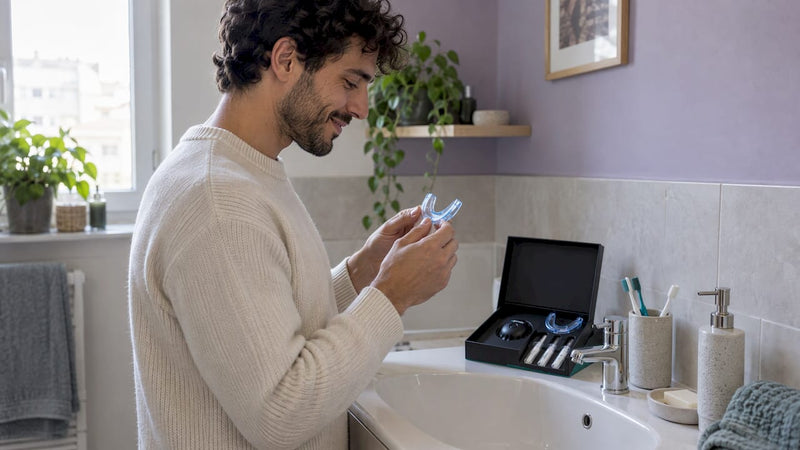
A cruelty-free whitening product, such as Esmile's at-home kits, which states CPNP certification and peroxide-free formulas, combines these elements instead of merely listing them on the label without verifiable evidence.
Key Points
Cruelty-free whitening requires verifiable third-party certifications, not just a label, and compliance with EU Regulation 1223/2009 alone is not enough to guarantee it.
| Point | Details |
|---|---|
| Cruelty-free is not vegan | The former concerns animal testing, the latter the origin of ingredients: they must be checked separately. |
| Certifications should be checked | Verify Leaping Bunny, PETA, or Vegan Society on the official certifier's website, not on the packaging. |
| PAP reduces sensitivity | It is an alternative to peroxide with a more gradual oxidizing action, useful for sensitive teeth. |
| Natural alternatives require consistency | Activated charcoal, baking soda, and enzymes work on the surface and should be used regularly, not intensively. |
| Esmile meets the checklist criteria | CPNP-certified kits, peroxide-free strips, and supervision by Dr. Marilena Troise. |
Table of Contents
- What “cruelty-free” means and how it differs from vegan
- Regulations and certifications: what really protects the consumer
- PAP, activated charcoal, and baking soda: what really works
- How to choose a cruelty-free whitener without making a mistake
- Why Esmile meets these criteria
- The Esmile option for those seeking ethical and safe whitening
- Sources
What “cruelty-free” means and how it differs from vegan
Cruelty-free means that neither the finished product nor the individual ingredients were tested on animals at any stage of development. It is a guarantee regarding testing methods, not composition. Veganism, on the other hand, refers to the complete absence of substances of animal origin in the formula, even if that formula were tested according to ethical standards. A product can be cruelty-free but not vegan if it contains, for example, beeswax or animal-derived glycerin, and vice versa, it can be vegan but lack testing certifications. Cruelty-free and vegan remain two distinct principles that should be assessed separately, not as interchangeable synonyms.
To understand if a whitening product contains animal traces, read the INCI list: look for entries such as gelatin, carmine, shellac, or glycerin of unspecified origin, which is often derived from animal fats.
- Beeswax (beeswax) appears in some whitening gels as a thickener.
- Carmine gives a red color to some pastes and is extracted from insects.
- Vegetable glycerin is the alternative to look for when the source is not declared.
One tip: don't stop at the seal on the packaging. Search for the brand name in the official Leaping Bunny or PETA databases: a “cruelty-free” label without verifiable certification is often just a marketing promise.
Regulations and certifications: what really protects the consumer
Regulation (EC) No. 1223/2009 prohibits animal testing for cosmetics sold in the European Union, for both the finished product and individual ingredients. The total ban has been in effect since 2013, when Europe extended the ban to ingredient testing carried out outside EU borders if the final product is then marketed in Europe, as explained by Pharma-G. This means that, in theory, every whitening product legally sold in Italy should already meet the basic cruelty-free criterion.
The problem is that the law establishes a minimum standard, not a certification. This is why third-party verifications matter:
- Leaping Bunny requires periodic audits extended to raw material suppliers, not just the final manufacturer.
- PETA offers two levels, “cruelty-free” and “cruelty-free and vegan,” verifying declarations provided by the company itself.
- Vegan Society certifies the absence of animal ingredients, but does not automatically cover testing methods.
- CPNP (Cosmetic Products Notification Portal) does not certify the ethics of the product, but attests to its safety of use through the mandatory notification to the European Commission.
A serious brand requires traceability even from raw material suppliers, not just checks on the finished product: it is one of the criteria that distinguishes companies truly committed from those that use the claim as a marketing tool. To verify a specific product, check the official certifier's website (leapingbunny.org or peta.org/cruelty-free), do not limit yourself to the logo printed on the packaging: Italian guides on the subject indicate that several brands reproduce similar logos without ever having obtained actual certification.
PAP, activated charcoal, and baking soda: what really works
Hydrogen peroxide remains the most studied whitening agent, but it is not the only option, nor is it the only one compatible with a cruelty-free approach. PAP (phthalimido-peroxypropionic acid) is promoted as an alternative that reduces tooth sensitivity compared to traditional peroxide, acting through a more gradual oxidizing mechanism on the molecules responsible for discoloration. The growing demand for ethical products is pushing the industry toward agents like this, which are less aggressive on the enamel and dental pulp.
Activated charcoal and baking soda work differently: they do not whiten the enamel deeply, but remove surface stains through mild mechanical abrasion. They work well on recent coffee or tea stains, but less so on older internal discolorations.
- Activated charcoal absorbs surface pigments but should be used in moderation, because too frequent use can dull the enamel.
- Baking soda has a more pronounced abrasive action: once or twice a week is fine, not every day.
- Enzymes (such as papain) break down the protein film on which pigments deposit, with a gentler action but slower results.
Natural alternatives effectively remove surface stains but require consistent use and remain less effective than treatments based on oxidizing agents on deep discolorations. Those with fillings, crowns, or particularly sensitive teeth should avoid daily use of abrasive products and prefer low-aggression formulas, first checking a guide on whitening for sensitive teeth. If you notice persistent pain, bleeding gums, or stains that do not respond to any home treatment, the next step is a visit to the dentist, not a more concentrated product.
How to choose a cruelty-free whitener without making a mistake
Before purchasing, follow these steps in order:
- Look for the logo of a recognized certification (Leaping Bunny, PETA, or Vegan Society) and verify it on the official certifier's website, not just on the packaging.
- Read the full INCI and check for the presence of ingredients of animal origin if you are also looking for a vegan formula.
- Evaluate whether you prefer a peroxide-free formula: if you have sensitive teeth or delicate gums, it is almost always the safer choice.
- Look for clinical evidence or safety tests published by the brand, not just generic reviews.
- Verify the supply chain policies declared by the company: transparent information about suppliers is a positive sign.
Before completing the purchase, write to the seller asking for the CPNP notification number or the certificate of conformity: a serious company will respond with verifiable documents, not with generic phrases.
Regarding costs, cruelty-free whitening kits sold online in Italy usually range between €20 and €60 depending on the technology (strips, gels, LED devices), while visible results generally require one to two weeks of consistent use, not a single application.
One tip: be wary of products that promise visibly whiter teeth after a single use: it is almost always a sign of overly aggressive formulas or exaggerated claims, regardless of whether they claim to be cruelty-free.

If the seller does not provide a readable INCI list, does not respond to direct questions about certification, or uses generic logos never associated with a recognized body, it is a sufficient red flag to look elsewhere.
Why Esmile meets these criteria
Applying the checklist just described to Esmile, the picture is consistent. The brand declares CPNP certification for the entire range and offers peroxide-free whitening strips, also designed for those with sensitive teeth. The collaboration with Dr. Marilena Troise adds professional supervision to the product development process, an element that many brands in the sector do not offer.

Sales volume also counts as an indirect sign of reliability: Esmile is a highly sold dental whitening brand on Amazon Italy. Such a high number does not automatically guarantee the ethics of the product, but makes it harder to hide quality or safety issues on a large scale: public reviews would quickly become a visible problem.
It must be said clearly: this article does not compare Esmile with other competing brands, because the goal is to help you understand what to look for, not to draw up a ranking. The checklist from the previous sections remains the most useful tool, whatever product you are evaluating.
The Esmile option for those seeking ethical and safe whitening
Esmile whitening kits combine LED technology, peroxide-free strips, and low-aggression gels, all CPNP notified to guarantee verifiable safety standards. It is a combination designed for those who want visible results on coffee, wine, or smoke stains without resorting to aggressive treatments or expensive dentist appointments.

The Esmile professional whitening kit is indicated for those who have already tried natural remedies like activated charcoal or baking soda without getting satisfactory results, but still want to avoid concentrated peroxide. It is also suitable for those with moderately sensitive teeth, thanks to the low-aggression formula. If you prefer a path supervised by a professional, you can consider whitening supervised by Dr. Marilena Troise, designed for those who want an additional check before starting. In any case, always follow the frequency instructions reported on the packaging: using the product more often than recommended does not speed up results, it only increases the risk of irritation.
Sources
- BRILLIANT Lumina — PAP description and benefits
- Tuttofarma — cruelty-free cosmetics: what it really means and how to recognize them