

Teeth whitening with retainers: it can be done, but with strict guidelines
Yes: you can whiten your teeth even if you wear retainers or aligners, but only with the right protocol. The key is that the whitening gel makes uniform contact with the enamel, which requires custom trays or explicit approval from your dentist to use the retainer itself as a tray. If you have active cavities or visible restorations on your front teeth, the first stop isn't the gel: it's the dental office.
In short:
- The most effective methods for whitening teeth with retainers or aligners involve using custom trays or the retainer itself as a tray, only with your dentist's consent.
- It is essential to avoid treatment in the presence of active cavities, visible restorations, or gingivitis, and to always follow a careful protocol to protect your gums and devices.
- Prolonged contact with the gel, for 4 to 8 hours a day for 10–16 days, ensures more lasting results and less sensitivity than single high-concentration sessions.
- A preliminary consultation allows you to assess the suitability of the treatment, have a professional cleaning, and choose the safest and most effective method.
- Clinical sources agree on the importance of application time and the preliminary check of oral health conditions before whitening.
Table of Contents
- Which methods work when wearing retainers or aligners
- How to whiten teeth safely: the step-by-step protocol
- Specific risks for retainer wearers and how to limit them
- How long whitening lasts and when it is best to do it
- What clinical sources say about whitening with devices
- Esmile's position on the responsible use of kits with retainers
- Esmile kits and products for home use with retainers
- Sources
- Frequently Asked Questions
Which methods work when wearing retainers or aligners
Not all dental whitening methods yield the same results for those wearing an orthodontic device. The difference lies in the product's ability to distribute the gel evenly, without leaving uncovered areas or points of accumulation.
- Custom trays with professional gel: they fit the dental arch perfectly and ensure constant contact between the gel and enamel, the factor that most affects the stability of the results according to the clinical experience reported by the Clinica Barbiera.
- Retainer used as a tray: possible only on the dentist's recommendation, because a device not designed to hold gel can lose its sealing precision or cause overflow onto the gums.
- Strips and universal kits: they fit poorly for those with aligners or braces, with irregular gel distribution precisely in the areas covered by brackets or attachments, a problem that specialized dental offices often report in those undergoing fixed orthodontics.
- In-office treatment or combined protocol: useful when stains are deep or when a visible effect is needed in a short time, to be followed by at-home maintenance.
Orthodontic devices, whether fixed or removable, can cover parts of the enamel and produce uneven results if not managed correctly: for this, the preliminary consultation with the dentist remains a step that should not be skipped.
How to whiten teeth safely: the step-by-step protocol
Those who wear a retainer cannot improvise. A precise sequence is needed, designed to protect both the teeth and the device.
- Visit and professional hygiene: the dentist removes tartar and plaque and checks for cavities or previous restorations, a step that makes the action of the gel more uniform.
- Impressions for custom trays: if the dentist advises against using the retainer as a tray, custom trays molded to your dental arch are used.
- Gel application: the amount must be minimal, just enough to cover the inner surface of the tray, avoiding overflow onto the gums.
- Contact times: the typical at-home protocol involves 4–8 hours a day for 10–16 days, and those who use aligners can integrate the application during the hours they remove them anyway for meals and hygiene.
- Device cleaning: always rinse the tray or retainer after each use to avoid gel residue and bacteria.
- Monitoring: if you notice reddened gums, persistent sensitivity, or irregular spots, stop and contact the dentist.
A tip: if you wear clear aligners, take advantage of the breaks between one set and the next to apply the gel: avoid alternating too many changes in your mouth on the same day and reduce the risk of irritation.
Before you start, it is worth reading our guide on cleaning before whitening: the preparatory phase determines a large part of the final result.
Specific risks for retainer wearers and how to limit them
Those who whiten while wearing a device face slightly different risks compared to those who do it with an empty mouth.
- Tooth sensitivity: it is the most common side effect. It is managed with desensitizing toothpastes or fluoride applications, without having to abandon the treatment halfway, as indicated by the practical instructions from AmicoDentista.
- Gum irritation: it almost always stems from an excessive dose of gel or a tray that does not hold its edges well.
- Discolorations around attachments or restorations: resins and fillings do not whiten like natural enamel, so they can remain darker and create a patchy effect after treatment.
- Contraindications to check beforehand: untreated cavities, active gingivitis, and pregnancy are conditions in which whitening should be postponed.
European regulations set a limit of 0.1% hydrogen peroxide in over-the-counter products, a threshold designed precisely to contain the risk of irritation if used without professional supervision.
How long whitening lasts and when it is best to do it
An in-office treatment gives a visible effect already after the first session, but tends to stabilize less over time compared to a prolonged at-home protocol. The prolonged contact time of the gel, typical of 10–16 days at 4–8 hours daily, produces more stable results with less sensitivity compared to single high-concentration sessions.
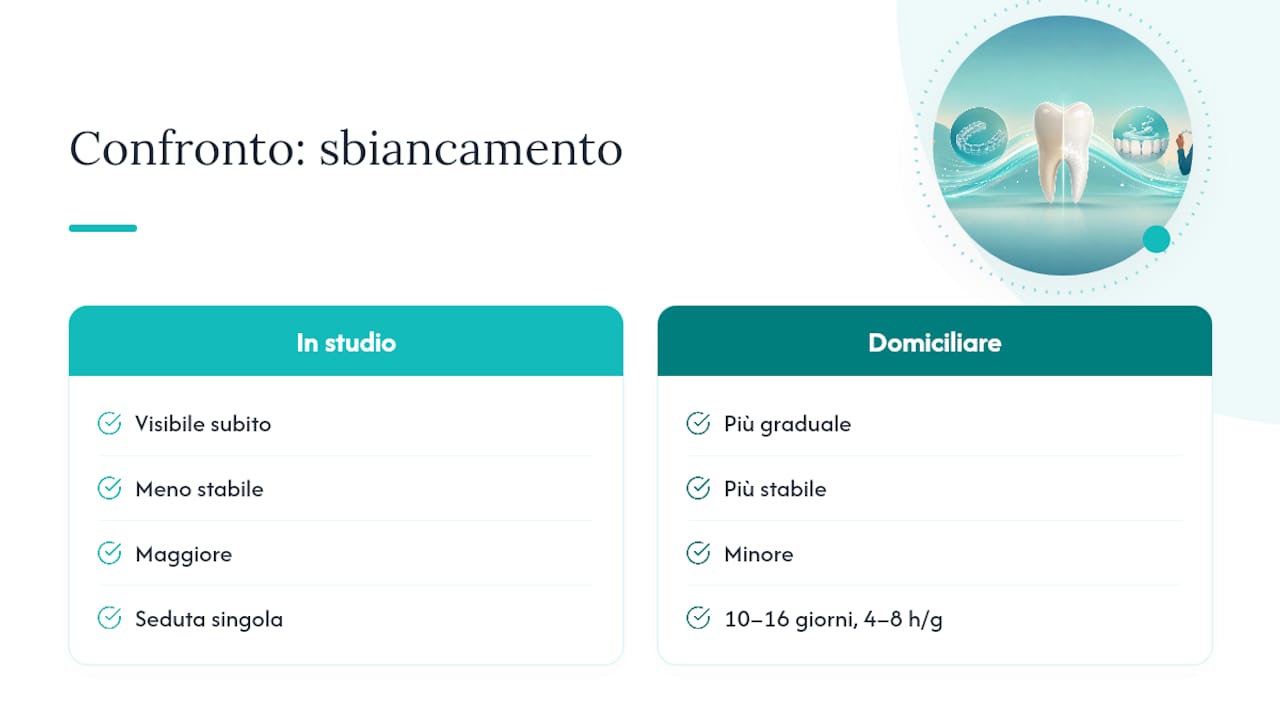
Many dentists suggest a combined protocol when stains are resistant: an in-office session for the immediate effect, custom trays at home to reinforce it. Maintenance then requires periodic touch-ups, generally every six or twelve months depending on your dietary habits. If you are still following a course with aligners, evaluate with the dentist whether to whiten now or wait until the end of treatment: the choice depends on the remaining duration of the aligners and the condition of the enamel.
What clinical sources say about whitening with devices
The recommendations of dental offices converge on a few firm points, all verifiable:
- The application time of the gel remains the most determining factor for the final result, more than the concentration of the product used.
- Over-the-counter products, legally limited to 0.1% peroxide, offer reduced effectiveness compared to protocols prescribed by the dentist.
- The preliminary visit and professional cleaning significantly reduce the risk of irregular results, an aspect that dental hygienists consider a prerequisite and not an optional choice.
Esmile's position on the responsible use of kits with retainers
A certified kit works well when there are no clinical contraindications, not when it replaces them. Before starting, a consultation with the dentist remains the most sensible step, especially if you have been wearing a retainer or aligners for a long time. Being clear about the limitations of an over-the-counter product is part of proper use just as much as using it well.
— Esmile
Esmile kits and products for home use with retainers
If the dentist has given you the green light and you have no cavities or previous restorations to manage, a well-chosen home kit can integrate well into your routine even with retainers or aligners. The Esmile Whitening Kits are CPNP-certified, formulated even for sensitive teeth, and designed to remove the most common stains, those from coffee, tea, wine, and smoking, without going to the dental office.

Those looking for a faster option for maintenance between one cycle and the next can opt for whitening strips, useful as a periodic touch-up rather than an intensive treatment. For those who already have a tray and just want to renew the product, gel refills are available. Remember, however, that a home kit does not replace a clinical evaluation: if you have doubts about cavities, inflamed gums, or visible restorations, talk to the dentist first, then choose the kit most suitable for your situation from the Esmile product collection.
Sources
The cited sources cover treatment times, peroxide regulations, and the clinical management of devices and restorations.
- Dental whitening in-office and at home: differences (Gruppo San Donato)
- Is it possible to whiten teeth with orthodontic braces? (Studio Dentistico Campana)
- Professional whitening vs. DIY kits (Studio Dentistico Cacciatore)
- Methods for whitening teeth at home: practical guide (DentalNetCare)
Frequently Asked Questions
Is it possible to whiten teeth with Invisalign?
Yes, with Invisalign whitening is generally easier than with fixed braces, because you can remove the aligners during gel application. However, the dentist's opinion is still needed, especially if you wear resin attachments that could whiten differently from natural enamel.
When can teeth whitening not be done?
Whitening should be postponed in the presence of untreated cavities, active gingivitis, or severe untreated tooth sensitivity. Pregnancy is also among the conditions in which most dentists recommend waiting.
How long do you wear the retainer?
It depends on the orthodontic plan established by the dentist, but generally retainers are worn full-time in the first few months and then only at night for long-term maintenance. If you are considering whitening at this stage, the typical at-home protocol requires 10–16 days with applications of 4–8 hours, times compatible with the evening use of the retainer.
Is it possible to whiten resin teeth?
No, composite resins do not respond to whitening gel like natural enamel and remain unchanged in color. If you have visible anterior restorations, it is preferable to plan the whitening together with a possible replacement of the restorations, to avoid color inconsistencies once the treatment is finished.


