LED teeth whitening light: real risks and how to avoid them
The LED light of a home whitening kit, on its own, is among the least risky elements of whitening: the problems you read about online almost always depend on the gel that accompanies it, its concentration, and how it is used. The most frequent effects are temporary sensitivity and some gum irritation, which generally disappear in a few days. This is why we at Esmile have chosen a peroxide-free formula, based on PAP, designed also for sensitive teeth and with CPNP-certified products. Here you will find what the research says, who should wait, and how to use an LED kit at home safely.
In brief
- LED light does not whiten on its own: it works together with a gel. The main risk comes from the gel, not the lamp.
- In a clinical study, violet LED light used alone caused sensitivity in 16% of patients, compared to 94.4% with hydrogen peroxide used in the office.
- Typical side effects, namely sensitivity to hot and cold and irritation, are temporary and usually pass in a few days.
- In Italy, products sold to consumers can contain a maximum of 0.1% hydrogen peroxide: higher concentrations are reserved for dentists.
- Pregnancy, breastfeeding, under 18 years old, cavities, or inflamed gums: in these cases, it is better to wait and consult your dentist first.
Table of Contents
- Does LED light hurt the teeth?
- The real risk factor is the gel
- Side effects: what they are and how long they last
- Who should wait before whitening
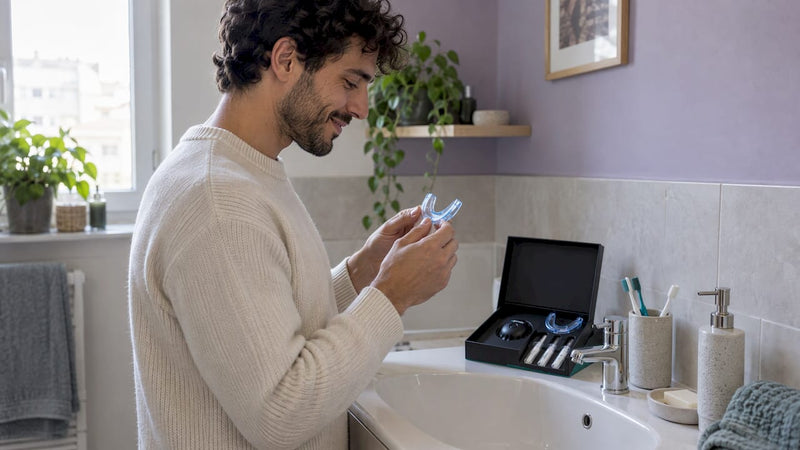
- How to use an LED kit at home safely
- LED in the office or kit at home: what really changes
- The Esmile kit for whitening at home without peroxide
- Our point of view
- Frequently asked questions
- Sources
Does LED light hurt the teeth?
It is the question asked by those whose teeth are stained by coffee, tea, or smoking and who are considering using a kit at home. The short answer is no: the light itself is not the delicate part of the treatment.
To understand why, you need to know what the light does. In whitening kits, the LED does not “color” the teeth white: it illuminates the gel applied to the enamel and accompanies its action. If you want to learn more about the mechanism, we have explained how LED whitening works step by step.
What studies say about light:
- Sensitivity. A randomized clinical trial on violet LED light compared several in-office treatments. LED alone produced the lowest risk of sensitivity, 16%, while hydrogen peroxide used in the office reached 94.4%. In the same study, no differences emerged in the mineral composition of the enamel (the ratio between calcium and phosphorus) between the treatments.
- Dental pulp. The pulp is the inner, living part of the tooth, with nerves and blood vessels. A systematic review by the UNESP University of 12 studies concluded that the effects of whitening on the pulp do not depend on the type of light, whether halogen, LED, or laser: what matters are the parameters with which the light is used, such as power and times.
- Whitening without peroxide. A systematic review from 2022 of 13 studies observed that violet LED, with a wavelength of 405-410 nanometers, has the potential to whiten teeth even without peroxides, with a perceptible change in color.
In practice, light is the calmest component of the treatment. If you are interested in the specific role of light colors, you will find a guide dedicated to blue LED for teeth.
The real risk factor is the gel
When talking about whitening damage, it is almost always about hydrogen peroxide. It is the classic whitening substance: it works, but the more concentrated it is, the more it increases the probability of sensitivity and irritation.
This is confirmed by a study of 40 patients: sensitivity after the treatment was longer and more intense with 35% hydrogen peroxide compared to 10% carbamide peroxide, regardless of the light source used. Carbamide peroxide is a compound that gradually releases hydrogen peroxide, in smaller quantities.

What the law provides in Italy
The rules are European, and the Ministry of Health summarized them in a note on dental whiteners:
- up to 0.1% hydrogen peroxide, present or released, the product can be sold freely to consumers;
- between 0.1% and 6% the product cannot be sold or distributed directly to the final consumer: the first use is reserved for the dentist.
For those who buy online, therefore, the first check is the label: a gel of uncertain origin, without declared concentration, offers none of these guarantees.
Why we use PAP
Our answer to this problem is to remove peroxide from the equation. The gels in Esmile kits use a peroxide-free formula based on PAP (phthalimidoperoxycaproic acid), which we have chosen because it is also suitable for sensitive teeth. All our products are CPNP-certified: this means they are notified in the European cosmetic products portal, the system with which the European Union registers cosmetics placed on the market. If you have had reactions to peroxide in the past, also read our guide on peroxide allergy.

Side effects: what they are and how long they last
The European Commission, in its scientific opinion on dental whiteners, indicates the most common adverse effects:
| Effect | How it presents | Typical duration |
|---|---|---|
| Dental sensitivity | Discomfort with hot or cold drinks | Usually disappears immediately or in a few days after the break, sometimes lasts over a month |
| Mouth irritation | Redness of the gums or mucous membranes where the gel came into contact | A few days after stopping |
| Mild digestive issues | Happens when you accidentally swallow a strip or the gel | Temporary |
Even the most recent research goes in the same direction. A 2025 review on clinical decisions in whitening indicates sensitivity as the central adverse effect, to be managed with tested protocols and desensitization strategies.
Then there is a piece of data that directly concerns those who whiten at home. An updated 2025 meta-analysis of 32 studies compared home whitening with in-office whitening: the intensity of sensitivity was significantly lower at home, the risk of having sensitivity was similar, and the result on color showed no significant differences.
If sensitivity appears, we have collected causes and remedies in the guide to post-whitening sensitivity.
Who should wait before whitening
Whitening is an aesthetic treatment for healthy mouths. The White Teeth guide of the Italian Dental Hygienists Association advises against it during pregnancy and breastfeeding and under 18 years old, and recommends doing it only on a healthy mouth, after a professional oral hygiene session.
Then there are situations where it is better to first solve the problem and then whiten. In these cases, the right person to consult is your dentist:
- Untreated cavities. The gel can reach already exposed areas and cause discomfort. We have explained when whitening with cavities is safe and when to wait.
- Inflamed gums or periodontitis. Bleeding gums must be treated first. You will find the details in the guide on whitening and periodontitis.
- Worn or eroded enamel. If the teeth appear transparent at the edges or very sensitive even before the treatment, read the guide on acid erosion and whitening.
- Fixed orthodontic appliance. With the brackets glued to the teeth, the gel does not act uniformly and it is better to wait until the end of the therapy. During orthodontic treatment, other habits involving gums and enamel also count, as explained in this guide on nicotine pouches and braces.
One last point to know before starting: whitening acts on natural teeth. Fillings, crowns, and veneers keep their color, so if you have any in the smile zone, it is useful to take that into account.
How to use an LED kit at home safely
With a compliant product and a healthy mouth, safety depends above all on how you use it. Here is the routine we recommend, with the most common mistakes at each step.
- Brush your teeth and floss. The gel must rest on clean enamel. The typical mistake is applying it immediately after a coffee, with residues and plaque that hinder contact.
- Read the label. Check ingredients and concentrations. With our peroxide-free gels, this step is simple; with an unknown product bought outside the EU, if the label does not indicate the concentration, do not use it.
- Use the indicated amount of gel. More does not mean whiter: excess gel overflows onto the gums and is the most common cause of irritation. If it touches the gums, remove it immediately with a cloth and rinse.
- Respect the session times. Follow the duration indicated in the kit instructions. Lengthening the sessions or doing two in a row increases the probability of sensitivity.
- Do not swallow the gel. During the session, do not eat or drink. At the end, rinse your mouth and the mouthpiece.
- Clean and store the mouthpiece. A clean and dry mouthpiece prevents the proliferation of bacteria between one session and the next. Our Esmile Aura Pro integrates a UV sterilizer precisely for this.
- Avoid stains in the following hours. Coffee, tea, red wine, and smoking are the main causes of stains: immediately after the session, it is advisable to limit them, so as not to nullify the work.
- Listen to your teeth. If sensitivity appears, space out the sessions or take a break for a few days. If the discomfort is strong or does not pass, stop and talk to your dentist.
LED in the office or kit at home: what really changes
Those looking for a brighter smile often ask if it is worth going to the dentist. The main differences concern who applies the gel, how concentrated it is, and how much the treatment costs.
| Aspect | LED whitening in the office | Esmile home LED kit |
|---|---|---|
| Whitening substance | High-concentration peroxide, applied by the dentist | Peroxide-free formula based on PAP |
| Gum protection | Necessary, with barriers applied in the office | The gel does not contain peroxide |
| Intensity of sensitivity | Higher according to the 2025 meta-analysis | Lower with home whitening according to the same meta-analysis |
| Organization | In-office appointments | Sessions at home, whenever you want |
| Cost | Office fee for each cycle | Kit purchased once, with separate gel refills |
The policy of the FDI, the International Dental Federation, establishes that high-concentration hydrogen peroxide products should not be used without gum protection: it is one of the reasons why those treatments remain in the office. If you are interested in the technical comparison between the two technologies, we have written a guide on LED and laser in whitening.
The Esmile kit for whitening at home without peroxide
If coffee, tea, wine, or smoking stains make you smile less willingly, the Esmile Aura Pro kit combines 32 LED lights, two interchangeable mouthpieces, and a UV sterilizer. The gel uses our peroxide-free formula based on PAP, designed also for sensitive teeth. Our kits are designed for results up to 7 shades whiter, and those who prefer blue and red light will find the Esmile Pro 32 LED kit.

All our products are CPNP-certified, cruelty-free, and vegan, and you have 30 days with a money-back guarantee. When the gel runs out, you will find the gel refills to continue the treatment with the same kit.
Our point of view
Every day we talk to people who would like whiter teeth but are afraid of damaging them. Almost always, this fear stems from the same two images: the light that “burns” and the gel that corrodes. Research indicates that the light is the safest part of the treatment and that the delicate point is the peroxide concentration.
This is why we built our kits starting with the gel. A peroxide-free formula based on PAP, suitable even for sensitive teeth, allows you to whiten at home without the concentrations reserved by law for the dental office. The red and blue LED light and the UV sterilizer complete a treatment designed to be repeated with peace of mind.
Our advice is simple: start with a healthy mouth, choose a certified product, and follow the instructions without rushing. Over 300 people choose Esmile every day for this reason, and we are the best-selling dental whitening brand on Amazon Italy.
Esmile
Frequently asked questions
What are the side effects of LED light whitening?
The most common are sensitivity to hot and cold and mild gum irritation. According to the European Commission, they usually pass in a few days after a break. They depend mainly on the gel and its peroxide concentration, not on the light.
Does LED light damage the enamel?
Studies do not indicate enamel damage due to LED light. In the clinical trial on violet LED light, no differences in the mineral composition of the enamel emerged between the treatments compared. However, if the enamel is already worn or eroded, it is best to have a dentist evaluate the teeth before starting.
What happens if I swallow a little gel?
A small amount accidentally ingested usually causes at most a mild, temporary digestive upset. Rinse your mouth with water and, in subsequent sessions, use less gel. If severe or persistent symptoms appear, contact your doctor.
How many times a week can whitening strips be used?
The correct frequency is that indicated in the product instructions, which vary from formula to formula. Our whitening strips are peroxide-free. If sensitivity appears, space out the applications.
Sources
- European Commission, opinion on tooth whiteners
- Kury et al., violet LED light and in-office whitening, 2020
- Benetti et al., types of light and pulp response, UNESP 2018
- Rossi et al., violet LED with or without peroxides, 2022
- Sensitivity in at-home and in-office whitening, Acta Odontológica Latinoamericana
- Kury et al., clinical decisions in whitening, 2025
- Geus et al., at-home and in-office whitening, meta-analysis 2025
- AIDI, White Teeth Vademecum
- FDI, policy statement on whitening materials