UV lamp for teeth: what are the real risks
A teeth whitening lamp used as directed is not in itself the risky part of the treatment: the most common side effects, namely sensitivity and gum irritation, depend mainly on the gel, its concentration, and how long it remains in contact with the soft tissues. This is why the choice that really makes a difference is the kit: LED light instead of UV rays aimed at the teeth, a peroxide-free formula, and safety certification. This is the path we have chosen at Esmile, with blue and red LED light kits, a peroxide-free (PAP) formula, and CPNP-certified products. Here you will find what risks exist, where they come from, how long they last, and how to avoid them.
In brief
- Almost all modern home kits use LED light, not UV lamps: UV light, when present, is used to sterilize the accessories.
- The most common side effects of whitening are temporary tooth sensitivity and gum irritation, mainly linked to peroxide gel.
- Gel concentration and contact time with the gums are the two factors that weigh most heavily on risk.
- Before whitening, cavities, tartar, and periodontitis must be treated; those who already have sensitive teeth must proceed with more care.
- A peroxide-free formula, respecting the times, and a well-positioned mask minimize discomfort.
Table of Contents
- UV lamp or LED light: what are we really talking about
- Where risks come from: the gel matters more than the light
- The most common side effects and how long they last
- Eyes, skin, and mucous membranes: precautions with light
- When it is better to wait before whitening
- How to use an LED kit safely, step by step
- Our point of view
- Whitening at home with Esmile
- Frequently asked questions
- Sources
UV lamp or LED light: what are we really talking about
When searching for a “UV lamp for teeth,” people often think of two different things. The first is the lamp used in some dental offices for professional whitening, a powerful light source to be used with protective glasses and precise procedures. The second is the small device in home kits, which is held in the mouth for a few minutes along with the gel.
In home kits, the light is almost always LED. LED (light-emitting diode) is the same technology as household light bulbs: it emits light of a precise color, usually blue, sometimes accompanied by red. Ultraviolet (UV) light is something else: it is the invisible radiation that, for example, tans the skin. Confusing the two is normal, also because many sellers use “UV” and “LED” as synonyms.
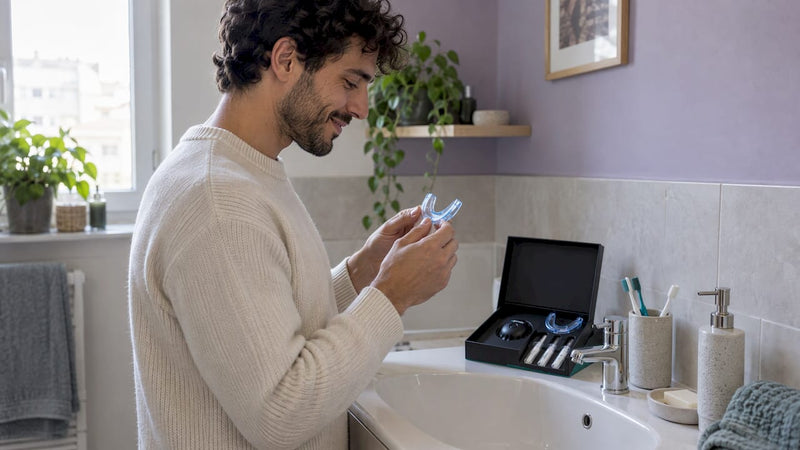
In our kits, the two technologies have separate roles: the blue and red LEDs accompany the gel during the treatment, while the UV technology is dedicated to sterilization. The Esmile Aura Pro kit, for example, combines 32 LED lights, two interchangeable mouthpieces, and a UV sterilizer. If you want to better understand what light does to the gel, you will find the details in our guide on LED-activated gel and in the comparison between LED and laser in whitening.

Where risks come from: the gel matters more than the light
The right question is not just “does the lamp hurt?”, but “what is in the gel that the lamp accompanies?”. Dental literature is clear on this point.
The ASSO Dental Association distinguishes the risk of the gel from that of the light: hydrogen peroxide is relatively safe as long as it remains on the tooth, while contact with gums and mucous membranes can cause damage. Two variables decide: concentration and duration of contact. Above 25% hydrogen peroxide, prolonged contact can irreparably damage the periodontium, i.e., the tissues that support the tooth. The same source reminds that products with hydrogen peroxide above 0.1% require a clinical protocol and a prior evaluation of teeth and gums by qualified personnel.
Even the FDI, the World Dental Federation, in its official position on whitening materials indicates that products with more than 6% hydrogen peroxide, or equivalents, should be used with caution and only in the office, because their long-term effects on pulp, dentin, enamel, and soft tissues are not fully known.

And reddened gums? According to the American Dental Association, gum irritation arises mainly from contact with peroxide gel, from masks that do not fit well, or from a poorly applied protective barrier.
In practice, the picture is this:
| Factor | Why it matters | How to reduce risk |
|---|---|---|
| Type of active ingredient | Peroxide is the agent linked to sensitivity and irritation | Choose a peroxide-free formula |
| Concentration | The higher it is, the more control and clinical protocol are needed | Use only products designed for home use |
| Contact time | Prolonged contact with the gums increases irritation | Respect the minutes indicated in the instructions |
| Mask fit | An unstable mask lets the gel flow onto the gums | Use a small amount of gel and position the mouthpiece well |
| State of teeth and gums | Cavities and inflamed gums amplify discomfort | Treat any problems first |
This is why our kits use a PAP-based peroxide-free formula (phthalimidoperoxycaproic acid), designed to be gentle even on sensitive teeth. If you want to delve deeper into the differences between active ingredients, read our guide on whitening without peroxide and the one on hydrogen peroxide for teeth.
The most common side effects and how long they last
Those who whiten their teeth, with any method, may notice two main discomforts. The FDI lists them as the most common effects: temporary tooth sensitivity and soft tissue irritation, during or immediately after the treatment.
Tooth sensitivity
It is a brief twinge upon contact with cold or hot foods and drinks. ASSO describes it as the most frequent adverse effect and explains that it is often reversible pulpitis, i.e., a mild inflammation of the inner part of the tooth that generally resolves within 24 hours. An Italian review from 2019 on whitening gels confirms that tooth sensitivity is generally reversible. The European Commission's report on whitening products notes that in some cases it can last more than a month: one more reason to choose gentle formulas and not extend the application times.
If sensitivity appears, there are simple precautions to reduce whitening sensitivity in the following days, such as a desensitizing toothpaste and a break between one session and the next. In our guide on post-whitening sensitivity you will find causes, duration, and remedies step by step.
Gum and mucous membrane irritation
It appears as a slight redness or burning along the gum line. According to the 2019 review, gingivitis and irritation tend to recede on their own in 24-48 hours. The most common cause is the gel leaking from the mask: this is why application technique matters more than the light. We have gathered practical tips in the guide on gum protection during whitening.
When discomfort is not normal
Severe pain that does not pass after a few days, or irritation that worsens instead of easing, is not among the expected effects. In this case, suspend the treatment and see your dentist, who can rule out a cavity or a gum problem that whitening has only made evident.
Eyes, skin, and mucous membranes: precautions with light
The light of a home kit works inside the mouth, in contact with the mouthpiece, but some common-sense precautions are always worth it:
- Do not stare at the light source: the blue light of LEDs is intense, so turn on the device only when it is already in the mouth and turn it off before removing it.
- Respect the session duration indicated in the instructions, without repeating multiple sessions in a row to speed up the result.
- Keep the mouthpiece clean: in kits with a UV sterilizer, cleaning the accessories is part of the routine; UV light is for the accessories, it should not be directed toward the eyes or skin.
- Photosensitivity and eyes: if you take medications that make you sensitive to light or have retinal diseases or cataracts, ask your doctor or ophthalmologist first if you can use a light device.
When it is better to wait before whitening
Whitening works on the color of the enamel, it does not treat teeth. This is why the 2019 Italian review indicates that cavities, tartar, and periodontitis must be treated before starting. Whitening over an open cavity or inflamed gums means amplifying exactly those discomforts you want to avoid.
Situations where it is advisable to stop and talk to the dentist first:
- Untreated cavities or broken fillings: the gel can reach unprotected areas of the tooth. Read when to whiten in the presence of cavities.
- Bleeding gums or periodontitis: first stabilize the gums, then whiten. We talk about it in whitening and periodontitis.
- Already very sensitive teeth: the 2019 review recommends evaluating the treatment with caution. A peroxide-free formula is the gentlest starting point.
- Bruxism: those who grind their teeth may have more sensitive teeth; you will find tips in whitening and bruxism.
- Pregnancy and breastfeeding, minors: in these cases, always ask the doctor's opinion before any cosmetic treatment.
Remember also that crowns, veneers, and composite fillings do not change color with whitening: if they are on the front teeth, take that into account before starting.
How to use an LED kit safely, step by step
A well-designed home kit makes it easy to do the right things. Here is the routine we recommend.
- Check the mouth and gums. No open cavities, no bleeding. If you have doubts, first have a check-up visit and a professional cleaning.
- Brush your teeth gently and dry them slightly. Avoid vigorous brushing immediately before, which can irritate the gums.
- Apply a small amount of gel. A thin layer on the inner surface of the mouthpiece is enough. Excess gel is what ends up on the gums, the most common cause of irritation according to the ADA. With the peroxide-free formula of our kits, this risk is already lower, but the rule still applies.
- Position the mouthpiece well and turn on the LED light only when it is in the mouth. The two interchangeable mouthpieces of Aura Pro are designed precisely to adapt better to the dental arch.
- Respect the times indicated in the instructions. More minutes do not mean whiter teeth, only more contact with the soft tissues.
- Rinse and clean the mouthpiece after each session; in kits with a UV sterilizer, use the dedicated function.
- Avoid foods and drinks that stain (coffee, tea, red wine) and smoking in the hours after the session, so as not to stain the newly treated teeth again.
- Maintain the result. The obtained color tends to darken gradually with daily habits; to understand how long teeth whitening lasts and when to do a touch-up, how much coffee and tea you drink matters a lot. Our gel refills for the kit are designed precisely for touch-ups.
If sensitivity appears, space the sessions by one or two days and resume when the discomfort has passed.
Our point of view
When we hear from people worried about the “risks of the UV lamp,” the answer almost always starts from the same point: the light should not be looked at alone, it should be looked at together with the gel. Dental sources link sensitivity and irritation mainly to peroxide, its concentration, and the contact time with the gums.
This is why we designed our kits around a peroxide-free (PAP) formula, intended to be safe even for sensitive teeth, and entrusted blue and red LED light with the work during the session, leaving the task of sterilization to UV technology. The products are CPNP certified, the European portal where cosmetics sold in the European Union are notified, as well as cruelty-free and vegan.
We believe that a brighter smile should be accessible and worry-free: anyone with stains from coffee, tea, wine, or smoking should be able to whiten their teeth at home with a clear, safe, and easy-to-use product. Over 300 people choose Esmile every day, and this drives us to keep our standards high.
Esmile
Whiten at Home with Esmile
If you want a brighter smile without peroxide gel, the Esmile Aura Pro kit combines 32 LED lights, two interchangeable mouthpieces, and a UV sterilizer, while the Esmile Pro 32 LED Blue and Red Light Kit is our dual LED light option. Our formula is designed for results up to 7 shades whiter and is also suitable for sensitive teeth.

All products are CPNP certified and covered by a 30-day money-back guarantee. Prefer a light-free alternative? You can also find peroxide-free whitening strips and the entire range of whitening kits and products.
Frequently Asked Questions
Is the LED light in whitening kits dangerous?
The LED light in home kits works inside the mouth, resting on the mouthpiece, for a few minutes. The most common side effects of whitening are mainly related to peroxide gel and its contact with the gums. Just do not stare at the light source and follow the indicated times.
Does lamp whitening damage the enamel?
Dental sources link tissue risks mainly to high concentrations of peroxide, which the FDI reserves for in-office use. This is why choosing a peroxide-free formula designed for home use, and using it according to the instructions, is the gentlest way to whiten at home.
How long does sensitivity last after whitening?
In most cases, just a few hours: ASSO describes it as reversible, generally within 24 hours, while gum irritation subsides in 24-48 hours. If the discomfort persists for days, stop and consult your dentist.
What not to do after a whitening session?
In the following hours, avoid coffee, tea, red wine, dark sauces, and smoking, which can restain the enamel. Do not immediately repeat another session to speed up the process: follow the frequency indicated in the kit instructions.
Sources
- ASSO dentistry: home dental whitening, rational use and contraindications
- FDI: policy statement on dental bleaching materials
- American Dental Association: Whitening
- Dental Whitening Gels: Strengths and Weaknesses (2019)
- European Commission: Tooth Whiteners, assessment