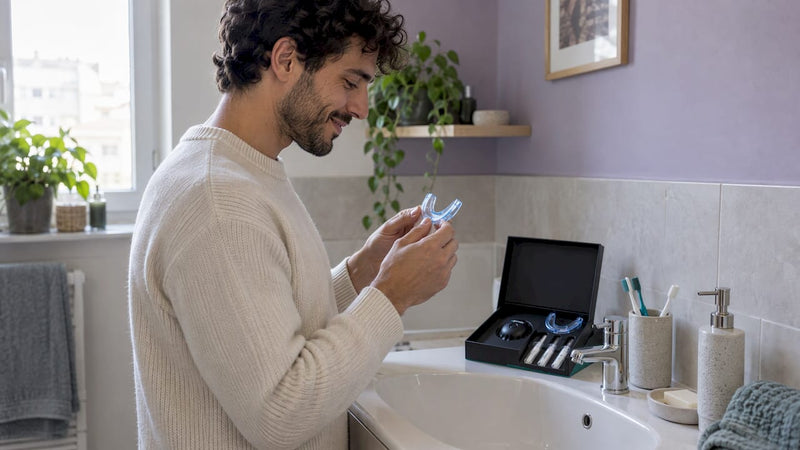
Purple gel: when to use it—the practical guide to safe whitening
We use purple whitening gel especially for superficial stains from coffee, tea, wine, and smoke, provided that the teeth and gums are healthy and the product complies with EU standards. It should not be applied in the presence of active cavities or gingivitis, during pregnancy, or by anyone under 18. Choosing certified formulas and respecting the indicated contact times reduces the risk of sensitivity and guarantees more reliable results.
In short:
- The gel works on superficial stains from coffee, tea, wine, and smoke; do not use it in case of cavities, inflamed gums, pregnancy, breastfeeding, or before the age of 18.
- In the EU, products with up to 0.1% peroxide can be sold freely; those between 0.1% and 6% must be dispensed by a dentist.
- Follow the indicated times, generally from 15 to 30 minutes, without increasing the dose or combining gel and strips in the same session.
- For maintenance, two or three applications per week are enough; if sensitivity appears, alternate the sessions with breaks and use a desensitizing toothpaste.
- Fillings, crowns, and veneers do not change color with the gel; if the enamel lightens, a color difference may become visible.
Table of Contents
- What purple whitening gel is and how it works
- When to use it: practical indications and contraindications to respect
- Step-by-step instructions for safely using purple gel at home
- Managing sensitivity and maintaining the result
- Why choose certified products and how we position ourselves as a practical option
- When to apply purple gel during treatment
- How to combine purple gel with other products for optimal results
- Indications for daily use or intensive treatment
- Author's perspective: balance between efficacy and caution
- Recommended products to start
- Frequently asked questions
- Sources
What purple whitening gel is and how it works
Purple whitening gel is a product for home use designed to lighten the surface of the teeth by acting on stains accumulated over time. It is applied using a tray, strips, or a brush and is placed alongside other tools such as activated charcoal and specific toothpastes, with a more targeted action on resistant stains.
The chemical mechanism is based on oxidation: peroxides, or alternatives such as PAP (phthalimidoperoxycaproic acid), break down organic pigments deposited on the enamel. The effect is not immediate and depends on the concentration of the active agent and the contact time, with a physiological limit beyond which the enamel does not lighten further.
The case is different for purple optical correctors, designed to optically neutralize the yellowish undertone of the teeth: they offer an immediate but temporary visual effect, which disappears with washing, without changing the structure of the enamel. A real whitening gel, on the other hand, acts chemically and cumulatively.
A supporting role is played by purple or LED light, used in some protocols as an aid to the gel. Clinical evidence shows that on its own it produces a perceptible but lesser color change compared to peroxide-based gels; combined with some gels, it can maintain similar efficacy while reducing the sensitivity reported by patients, as emerges from a study on the use of violet light in professional whitening.
In summary, before choosing a product, it is useful to distinguish:
- Chemical gel: acts on pigments through oxidation, with results progressing over time.
- Purple optical corrector: immediate and temporary effect, useful for a quick touch-up.
- Violet/LED light: optional support, less effective on its own than the gel.
When to use it: practical indications and contraindications to respect
Purple gel works best on extrinsic stains, those that deposit on the surface of the enamel due to daily habits. The most suitable situations are stains from coffee, tea, red wine, and smoke, as also indicated by the British National Health Service guidelines on teeth whitening.
Before proceeding, let's check that none of these conditions apply:
- Active cavities or other untreated dental conditions.
- Gingivitis, periodontitis, or frequent bleeding gums.
- Pregnancy or breastfeeding.
- Age under 18.
- Marked tooth sensitivity without a prior dental consultation.
In all these cases, the dentist's opinion comes before any home application.
Another point to know concerns the European regulation on hydrogen peroxide concentration. Products with a percentage equal to or less than 0.1% can be sold freely to consumers, while formulations between 0.1% and 6% must be dispensed by a dentist, as established by the EU regulation on whitening products. This limit is not a formality: beyond certain thresholds, the risks of irritation and damage to soft tissues increase, which is why choosing a compliant product accompanied by clear instructions is the basis for safe home use.
Step-by-step instructions for safely using purple gel at home
Before starting, a quick check of your oral hygiene and, in case of doubts about cavities or inflamed gums, a consultation with the dentist will prevent unnecessary complications. Once it has been verified that the teeth are in good condition, we can proceed with these steps:
- Brush your teeth with a soft toothbrush, without forcing the enamel.
- Apply a minimum amount of gel to the tray or strip, avoiding direct contact with the gums.
- Position the tray or strips following the contact times indicated on the packaging, generally between 15 and 30 minutes.
- Remove the product and thoroughly rinse your mouth with warm water.
- Repeat the cycle according to the recommended program, spreading the applications over several days instead of concentrating them.
The amount of gel should never be increased to “accelerate” results: excess does not improve efficacy and increases the risk of gum irritation, as reported in the information for adult patients on teeth whitening.
A tip: if we notice increasing sensitivity, alternate one application evening with one rest evening, perhaps using a desensitizing toothpaste in the tray instead of the gel.
In case of an adverse reaction, such as intense burning or gum swelling, stop the treatment immediately, rinse with water, and, if the discomfort persists, contact the dentist. For those who want to learn more about the procedure, our complete guide to using whitening gel at home offers additional step-by-step instructions.
Managing sensitivity and maintaining the result
Tooth sensitivity is the most common side effect during at-home whitening and is best managed with small adjustments rather than the complete interruption of the treatment.
- Alternate gel applications with rest evenings, using fluoride or hydroxyapatite-based desensitizing toothpastes.
- Reduce the frequency of sessions if persistent discomfort appears, as suggested in dental guidelines on managing sensitivity during whitening.
- Avoid highly pigmented foods and drinks in the hours following the treatment, when the enamel is more permeable.
To maintain the result over time, the daily routine counts as much as the treatment itself: limiting coffee, tea, red wine, and smoke, or rinsing your mouth immediately after consumption, slows the reappearance of stains. We explore these aspects in the guide on how to maintain teeth whitening over time.
A practical warning: fillings, crowns, and veneers do not react to whitening gels like natural enamel. If the color difference becomes visible after the treatment, the only solution is a specific dental intervention on those materials.
Why choose certified products and how we position ourselves as a practical option
Choosing a CPNP-certified gel means relying on a controlled formulation, an element that reduces the risk of encountering non-compliant products or those with out-of-regulation peroxide concentrations, a concrete risk also reported in informational materials on unauthorized whitening and non-compliant kits.
We offer CPNP-certified products that include purple strips, whitening gel, and refills designed for maintenance cycles. For those with recent and superficial stains, purple strips are a good starting point; for more resistant stains, the gel in a tray offers a more targeted and prolonged action over time.
When to apply purple gel during treatment
The right time to apply purple gel depends on the type of kit we are using. In kits that include a tray and gel, the application occurs as the main treatment: the gel should be spread directly on the clean and dry tray, then positioned on the teeth for the indicated contact time.
When, however, the gel is used together with whitening strips, the sequence changes: the strips generally represent the basic treatment for removing the most widespread extrinsic stains, while the gel in a tray can be reserved for a second time of the day or for alternating days, to intensify the action on areas with more marked stains, such as the edges between the teeth.
It is not advisable to combine gel and strips in the same session: this does not accelerate results, but only increases the exposure time of the soft tissues to the whitening agent. It is better to distribute the applications throughout the week, always leaving a rest period between one treatment and the next.

For those who also use a device with violet or LED light as an aid, the exposure should be placed immediately after removing the gel, when the teeth are still clean and free of residue, not before application. This order respects the logic of clinical protocols that provide for light as a subsequent, not replacement, phase of the chemical action of the gel.
How to combine purple gel with other products for optimal results
Purple gel works best when it is part of a routine that also includes strips, toothpaste, and activated charcoal, each with a different role in the whitening journey.
Purple whitening strips work well as a regular treatment for widespread and superficial stains, especially those related to smoke and wine. The gel, applied in a tray on the following or alternating days, instead acts on the areas where the stain is more concentrated, such as the space between the incisors.
Toothpaste and activated charcoal have a complementary, not replacement, function: they act mechanically on the surface of the enamel and help remove plaque residue and the most recent stains before they even deposit deeply. Using them in the morning, reserving gel and strips for the evening, is a practical sequence that many people find convenient.
A typical combination for those starting from scratch could include: activated charcoal toothpaste for daily cleaning, purple strips two or three times a week as a maintenance treatment, and gel in a tray reserved for the most stained areas, with regular breaks to protect the gums. This gradual approach, rather than the simultaneous use of multiple products in the same session, tends to give more stable results over time without increasing the risk of sensitivity.

Indications for daily use or intensive treatment
The frequency with which you use purple gel depends on the goal: daily maintenance or a more intensive intervention on rooted stains.
For maintenance use, it is enough to apply the gel two or three times a week, alternating with desensitizing toothpaste on rest days. This pace is enough to counteract the accumulation of new stains from coffee, tea, or smoke without subjecting the enamel to continuous stress.
For a more intensive treatment, indicated when stains are older or more marked, the application can become daily for a limited cycle, usually for several consecutive days, followed by an observation break before evaluating whether to continue. In this phase, it is important to monitor any signs of sensitivity and immediately reduce the frequency if discomfort appears, following the same sensitivity management principles valid for any home whitening protocol.
In both cases, the program must not exceed the contact times indicated on the product packaging, nor increase the amount of gel to try to achieve faster results. Hydrogen peroxide, when present in the formulation, remains an ingredient to be handled according to the concentrations allowed for free sale, a topic we explore in the guide dedicated to hydrogen peroxide for teeth.
Author's perspective: balance between efficacy and caution
Purple gel works, but only when we treat it as part of a journey, not as a shortcut. The best results come to those who respect the times, listen to the signals of sensitivity, and do not hesitate to ask a dentist for an opinion in case of doubt. Caution does not slow down results: it makes them last longer.
— Esmile
Recommended products to get started
If you're wondering where to start, the choice depends on the type of stains and how much time you want to dedicate to the treatment.

- Purple whitening strips: ideal as a first step for widespread smoke and wine stains, to be used two or three times a week.
- Whitening kit with gel mask: suitable for more concentrated or resistant stains, with supporting LED technology.
- Gel refills: useful for continuing maintenance once the first cycle is finished, without having to repurchase the entire kit.
All our products are CPNP certified and also designed for those with sensitive teeth. We can explore the entire range in the whitening kits and products section, or start directly with the whitening strips if the stains are recent and superficial.
This article provides general information and does not replace the opinion of a qualified medical professional. Consult a qualified healthcare professional regarding your specific case before acting based on this content.
Frequently asked questions
Does the purple gel really whiten teeth or is it just an optical effect?
The purple whitening gel based on peroxide or PAP acts chemically on pigments and produces a real and progressive effect, different from optical correctors that temporarily mask the color. The chemical action requires multiple applications spread over time to give visible and lasting results.
How long should the purple gel be left on?
The application times vary depending on the product, but generally range between 15 and 30 minutes per application, as indicated on the packaging. Exceeding the recommended times does not improve the result and only increases the risk of gum irritation.
Can the purple gel be used with sensitive teeth?
It is possible, but it is advisable to alternate applications with desensitizing toothpastes and reduce the frequency if discomfort appears, as indicated in the guidelines on managing sensitivity during whitening. For those with marked sensitivity, our guide to whitening for sensitive teeth proposes a more gradual path.
Which stains are not removed by the purple whitening gel?
The gel acts on superficial extrinsic stains, such as those from coffee, tea, wine, and smoke, but does not change the color of fillings, crowns, or veneers. Intrinsic stains, linked to the internal structure of the tooth, require specific dental evaluations and treatments.
Is it legal to buy purple whitening gel without a dentist's prescription?
Yes, products with a hydrogen peroxide concentration equal to or less than 0.1% can be sold freely to consumers according to EU regulations on whitening products.
Sources
- Tooth Whiteners & Oral Hygiene Products containing hydrogen peroxide
- Teeth whitening - NHS
- Tooth whitening information for adult patients - Leeds Teaching Hospitals NHS Trust
- Effect of violet LED light on in-office bleaching protocols - PMC
- Pharmacy dental fact sheet - tooth whitening (NHS)