Gray teeth: a practical guide to whitening at home
A grey tooth can be a simple removable stain or the sign of a serious clinical problem: understanding which one it is should be your priority. If the discoloration affects multiple teeth and is linked to coffee, tea, wine, or smoking, a certified home kit can help. If, however, a single tooth has become darker over time without an obvious cause, a visit to the dentist should come before any whitening treatment.
- Surface stain (coffee, tea, wine, smoking): pigments deposit on the enamel and respond well to home kits.
- Internal discoloration (pulp necrosis, tetracycline, fluorosis, trauma): the color comes from the dentin, and home kits cannot reach it.
- Sign of trust: CPNP-certified products comply with the safety limits set by European regulations, which also apply in Italy.
- Esmile has over 300 purchases a day on Amazon.it, making it the best-selling whitening brand on the platform in Italy.
Table of Contents
- Why a tooth becomes grey: external or internal discoloration?
- Does home whitening work on grey teeth?
- When a grey tooth requires an urgent visit
- How to choose a whitening kit for stains from coffee, tea, wine, or smoking
- Why a certified kit like Esmile is a valid home option
- How to use a whitening kit at home safely
- How to maintain results and reduce the return of stains
- Key points
- Caution and certified kits: our point of view
- Esmile kits for stains from coffee, tea, wine, and smoking
- Sources and useful resources
Why a tooth becomes grey: external or internal discoloration?
The practical distinction is simple: look at how many teeth are involved and think about your habits.
External discoloration. Coffee, tea, red wine, and smoking deposit pigments on the surface of the enamel. The result is often a yellow-brown color that, over time, can turn a dull grey. These pigments remain on the surface, and home whitening effectively removes them.
Internal discoloration. When the color comes from inside the tooth, the situation changes. Trauma that has interrupted the blood flow to the pulp, pulp necrosis, the intake of tetracycline during childhood, or fluorosis lead to a grey-blue discoloration that no home kit can correct, because kits act on the enamel and do not penetrate into the dentin.
"Whitening does not create a universal white: it aims to lighten the natural shade of the tooth and harmonize the smile, measured on scales such as VITA A1–D4." — Dr. Giuseppe Massaiu, Massaiu Dental Centers
How to distinguish them in practice. If all the teeth appear uniformly dull and you drink coffee every day, the cause is almost certainly superficial. If, however, a single tooth, perhaps a canine or incisor, has become darker than the others without an obvious reason, suspect an internal cause.
A tip: take photos of your teeth in natural light before buying any product. If the discoloration affects only one tooth, show the photo to your dentist before proceeding.

Does home whitening work on grey teeth?
The answer depends entirely on the cause. For superficial stains from coffee, tea, wine, and smoking, home kits work well. For grey discolorations of internal origin, their effectiveness is limited or non-existent.
- It works: stains from pigmented beverages, smoking, and the accumulation of colored plaque.
- It does not work: discoloration from tetracycline, pulp necrosis, fluorosis, and metal restorations.
- Be careful with restorations: whitening does not change the color of fillings, crowns, or ceramic veneers. After treatment, a color discrepancy between natural teeth and restorations may emerge.
Home kits are useful for daily aesthetic maintenance, but they do not treat discolorations resulting from diseases or trauma. In these cases, endodontic or prosthetic approaches are required.
A tip: if you have doubts about the nature of the discoloration, take a photo in natural light and compare it with your dentist before buying a kit.
When a grey tooth requires an urgent visit
Some signs should not be ignored. A tooth that turns grey in isolation may indicate pulp necrosis or past trauma and requires immediate dental evaluation.
- A single tooth that gradually darkens without an apparent cause.
- Spontaneous pain or a sudden loss of sensitivity to hot/cold.
- Swollen gums, a visible abscess, or a persistent bad taste.
- A tooth darkened after trauma, even if the trauma occurred years ago.
This last point deserves attention: dental trauma may not cause color changes for months or even years. Many people do not connect a dark tooth to a fall or a blow sustained some time ago.
A necrotic tooth can harbor bacteria that spread silently, putting the bone and neighboring teeth at risk. Root canal treatment is often necessary before any internal whitening.
In these cases, internal endodontic whitening is performed by the dentist, who places the whitening agent directly into the pulp chamber after root canal treatment, with 1–3 in-office applications. This is not something that can be replicated at home.
How to choose a whitening kit for stains from coffee, tea, wine, or smoking
For those buying online in Italy, these are the criteria that really matter.

A tip: always check the CPNP certification before buying: it is the minimum requirement for cosmetics sold in the European Union and guarantees that the product has been notified to the competent authorities.
| Criterion | What to check |
|---|---|
| Certification | CPNP mandatory for EU/Italy products |
| Active ingredient | Peroxide (more effective) or peroxide-free (gentler) |
| Sensitive teeth | Look for formulas with desensitizers or specific gels |
| Product type | LED kit, strips, pen, charcoal powder, or purple gel |
| Duration per session | Generally minutes; check the instructions |
| Price | Home kits: affordable variable prices; professional whitening: more expensive treatment. |
- LED kits: they combine gel and light to accelerate the whitening effect; suitable for complete treatments.
- Strips: practical and discreet, good for those with little time.
- Pens: ideal for maintenance or targeted touch-ups.
- Charcoal powders: they remove surface pigments; use sparingly to avoid abrading the enamel.
Why a certified kit like Esmile is a valid home option
For those with stains from coffee, tea, wine, or smoking, a certified home kit is a sensible, affordable, and safe choice if used correctly.
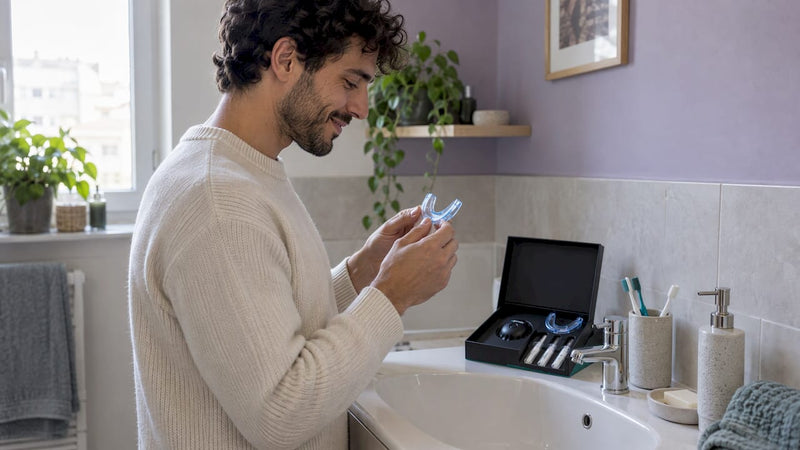
Esmile offers kits with LED technology, CPNP-certified gels, specific versions for sensitive teeth, and gel refills to prolong the treatment over time. The products are designed to remove surface stains gradually without requiring an in-office visit.
- CPNP certification: compliance with European cosmetic safety regulations.
- Peroxide-free options for those with sensitive teeth or who prefer gentler formulas.
- Gel refills and accessories available to maintain results over time.
Those who use Esmile regularly for smoking stains may also find the guide on smoker's teeth useful for understanding how to address more resistant discolorations. Esmile has over 300 purchases a day on Amazon.it, with reviews confirming visible results within the first few weeks of use.
How to use a whitening kit at home safely
Preparation
Brush your teeth thoroughly before applying the gel. Take a photo in natural light to compare the results. Do not use the kit if you suspect necrosis, have recent restorations that have not been evaluated, or have irritated gums.
Procedure
- Apply the gel to the strip or tray following the product instructions.
- Place the tray or strip on your teeth, making sure the gel does not touch your gums.
- Activate the LED lamp if included in the kit and follow the indicated time.
- Remove the tray, rinse thoroughly, and do not eat or drink for at least 30 minutes.
For detailed instructions and specific warnings, consult the guide on how to whiten teeth at home.
| Parameter | Typical indication |
|---|---|
| Duration per session | a few minutes, from a few minutes to half an hour |
| Frequency | Once a day or every other day |
| Recommended cycle | 1–2 weeks |
| Interval between cycles | 4–8 weeks |
If you experience intense sensitivity, stop the treatment and read the information on side effects and safety.
How to maintain results and reduce the return of stains
Home whitening results last approximately 12–24 months, but smoking and frequent consumption of coffee, tea, or wine significantly reduce this window.
- Brush your teeth immediately after drinking coffee, tea, or wine: reducing the contact time of pigments is the most effective prevention strategy, often more useful than frequent whitening touch-ups.
- Floss every day and use an alcohol-free mouthwash to keep the enamel clean.
- Plan a home touch-up every 12–24 months with a pen or light strips.
- For quick surface stains, activated charcoal powder can help, but use it sparingly.
A tip: dentists recommend immediate brushing after pigmented beverages as a primary prevention strategy. It costs nothing and works better than any whitening touch-up.
Key points
Distinguishing surface discoloration from internal discoloration is the first step: only stains on the enamel respond to home kits, while internal discolorations always require a dentist.
| Point | Details |
|---|---|
| External vs. internal discoloration | Stains from coffee/tea/wine/smoking: home kits are effective. Grey from necrosis or tetracycline: a dentist is needed. |
| Warning signs | A single tooth that darkens, pain, or swelling: dental visit before any whitening. |
| CPNP certification | Choose only products with CPNP certification: it is the minimum safety requirement for cosmetics in Italy and the EU. |
| Duration of results | Results last on average 12–24 months; smoking and pigmented beverages reduce the duration of results. |
| Esmile | CPNP-certified LED kits, options for sensitive teeth, and gel refills: recommended home solution for surface stains. |
Caution and certified kits: our point of view
There is a widespread tendency to treat any dark tooth as an aesthetic problem to be solved with whitening. It is a mistake that can have serious consequences. An isolated grey tooth that worsens over time is not a coffee issue: it is a sign that deserves an X-ray, not a gel.
That said, the vast majority of those seeking whitening have genuine surface stains caused by daily habits, and a certified home kit is a concrete, safe, and affordable answer. CPNP certification is not a marketing detail: it is the guarantee that the product has passed the checks required by European regulations. Choosing a kit without that certification means relying on something that has not undergone any formal verification.
The advice we always give is simple: if you have doubts about the nature of the discoloration, see a dentist first. If the cause is superficial, a kit like those from Esmile will do its job. If the cause is internal, no home kit will help you, and the sooner you know, the better.
Esmile kits for stains from coffee, tea, wine, and smoking
Those with surface stains who want visible results without waiting for an in-office appointment have a direct path: the Esmile professional whitening kit, with LED technology and CPNP-certified gel.

Esmile offers versions for sensitive teeth, gel refills to prolong the treatment, and charcoal powders for daily maintenance. All products are available on Amazon.it with fast shipping in Italy. For those who prefer professional support before starting, the evaluation with Dr. Marilena Troise is also available. Choose the product best suited to your situation on the Esmile products page and start the treatment with the certainty of using something safe and verified.
Sources and useful resources
The clinical sources listed here can be useful to bring to the dentist to discuss the nature of your discoloration. Esmile resources guide you in the correct use of the products.
Clinical and dental sources:
- Dental whitening: truth, duration, and difference between whitening and lightening — Massaiu Dental Centers
- Grey tooth: causes and remedies — Dr. Emanuele Pelagalli, Rome
- Why does a tooth turn gray? Causes and how to whiten it — Studio Rao
- Teeth whitening: how it works and protocol — DentalSì
Esmile resources for further reading:
- Teeth whitening: how long it lasts and how to maintain it
- Does teeth whitening hurt? Side effects and safety
- Professional or at-home whitening? How much does it cost?
| Resource | Type | Useful for |
|---|---|---|
| Centri Odontoiatrici Massaiu | Italian clinic | Realistic expectations about whitening |
| Studio Rao | Italian clinic | Causes of gray teeth and internal whitening |
| DentalSì | Italian clinic | Limitations of kits for internal discoloration and restorations |
| Esmile Blog | Home guide | Safe use, maintenance, and costs |