

Mouthwash after whitening: what to choose and why
After whitening, choose an alcohol-free mouthwash enriched with fluoride or remineralizing agents: it is the choice that protects the enamel made more porous by the treatment and reduces sensitivity in the following days. If your teeth are particularly sensitive to cold or heat, it is better to opt for desensitizing formulas. At this stage, the priority is not to seek further whitening, but to consolidate the results achieved.
In short:
- After whitening, it is essential to use an alcohol-free mouthwash with fluoride to protect the enamel and reduce sensitivity, especially in the first 48-72 hours.
- It is important to avoid aggressive, minty mouthwashes or those with chlorhexidine in the long term, as they can cause pigmentation or irritation on the newly treated enamel.
- The correct technique involves rinsing at least 30 minutes after brushing, for 30-60 seconds, and without diluting the product with water.
- For those who experience marked sensitivity, desensitizing mouthwashes with potassium salts or specific fluorides are recommended and should be chosen based on the dentist's instructions.
- Too early or incorrect use can compromise the whitening results, so personalizing the protocol with a professional remains essential.
Table of Contents
- When to start using mouthwash after whitening
- Which formulations to choose for post-whitening care
- How to use mouthwash after whitening: technique and frequency
- Ingredients to avoid and warnings to know
- Mouthwash, fluoride and remineralization: what really makes the difference
- Recommended daily routine after whitening
- Why the choice of mouthwash should be personalized by a professional
- Mouthwash is not enough on its own: what is Esmile's role in maintenance
- Why it is advisable to rely on a custom protocol
- Sources
- Frequently asked questions
When to start using mouthwash after whitening
In the first few hours after the session, avoid aggressive or highly minty mouthwashes: the enamel is temporarily more permeable and the tissues are dehydrated, so any strong product risks irritating the gums. Always follow the specific instructions given by the professional who performed the treatment, as they vary depending on the technique used.
The first 48/72 hours represent the most delicate window: teeth are more receptive to both food pigments and the ingredients of hygiene products. Thermal sensitivity, which in most cases resolves in a couple of days, can last up to one or two weeks in some people. During this period, mouthwash does not work alone:
- Fluoride toothpaste: should be used at every brushing to strengthen the enamel day after day.
- Alcohol-free mouthwash with fluoride: is added to the routine as a second level of protection, not as a substitute for brushing.
- Remineralizing mousse or gel: if prescribed by the dentist, they are used at the indicated times, often in the evening before going to bed.
Maintaining this combination for about two weeks helps the enamel regain its natural balance, as confirmed by clinical guidelines on the constant use of fluoride after treatment.
Which formulations to choose for post-whitening care
Not all mouthwashes work the same way on newly treated enamel. Some components help, others risk undoing part of the work done.
- Avoid alcohol: it dries out the gum tissues and can accentuate discomfort in the first few days, when nerve endings are more exposed.
- Be wary of highly minty or "strongly refreshing" mouthwashes: the stinging effect often corresponds to a more aggressive formula, not recommended immediately after treatment.
- Look for fluoride: it remains the ingredient with the most solid role in remineralization, useful for strengthening the enamel and reducing sensitivity in the following weeks.
- Consider agents such as amorphous calcium phosphate: they act by depositing minerals on the tooth surface, providing an extra layer of support beyond fluoride.
- If sensitivity is marked, opt for desensitizing formulas: those based on potassium salts or specific fluorides are designed precisely to reduce the transmission of pain to the nerve.
A mouthwash for white teeth that promises an additional whitening effect is not the priority at this stage: the goal is to protect, not to add further chemical stress to the enamel.
A tip: always read the label before buying: "alcohol-free" and "with fluoride" must both appear; one of the two is not enough to consider it suitable for post-treatment.
How to use mouthwash after whitening: technique and frequency
Correct use is almost as important as the choice of product. A good mouthwash, used incorrectly, loses much of its effectiveness.
- Wait about 30 minutes after brushing before switching to mouthwash: using it too early can wash away part of the active ingredients of the toothpaste just applied.
- Respect the dose indicated on the label, generally a rinse of 30 or 60 seconds: prolonging it does not increase the benefits and can irritate sensitive tissues.
- Do not dilute the product with water: the concentration is calibrated by the manufacturer, and diluting it reduces the effectiveness of the active ingredients.
- Avoid rinsing with water immediately after: let the mouthwash continue to work on the tooth surface instead of removing it immediately.
Repeat the routine once or twice a day, unless otherwise instructed by the dentist or dental hygienist.
Ingredients to avoid and warnings to know
Not all mouthwashes available in pharmacies are recommended for those who have just whitened their teeth. Some active ingredients, although effective in other contexts, deserve specific attention.
- Chlorhexidine: it is a powerful antibacterial, but if used for a long time, it can cause yellow-brown pigmentation right on the newly lightened enamel. It should only be used on professional recommendation and for limited periods, never as a routine daily mouthwash.
- Alcohol and highly aggressive formulas: they increase the risk of gum irritation and can worsen sensitivity in the first few weeks.
- Prolonged use of antibacterials without supervision: it can persistently alter the perception of taste, in addition to the risk of stains.
If you notice unusual stains, an increase in pain instead of a decrease, or an alteration of taste that does not pass in a few days, stop using the mouthwash and contact the dentist. These signs are not normal and must be evaluated in person.
Mouthwash, fluoride and remineralization: what really makes the difference
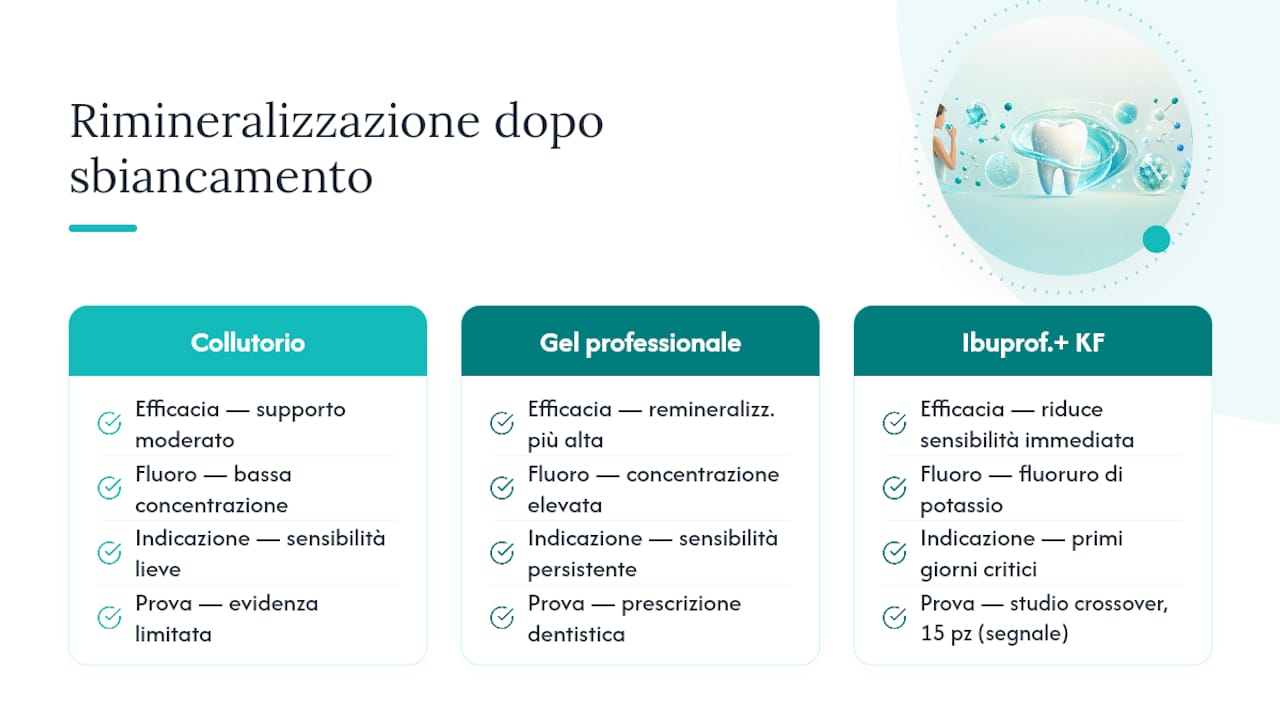
Fluoride remains the most reliable ally for rebuilding the enamel surface after treatment, but mouthwash is not always sufficient on its own. In cases of more intense sensitivity, the dentist can prescribe professional gels or mousses with higher concentrations of fluoride, to be applied with specific trays at home.
Some clinical studies have also investigated targeted pharmacological approaches for the first, more critical days.
A crossover study with 15 patients observed that the combination of ibuprofen and potassium fluoride reduces immediate sensitivity after whitening more effectively than the isolated use of the two components.
This is a small sample, so the data should be read as an interesting signal rather than a definitive proof. If sensitivity continues to be bothersome beyond the first week, it is worth asking the dentist for a home protocol with trays and fluoride gel: it offers more concentrated remineralization compared to over-the-counter mouthwash alone.
Recommended daily routine after whitening
A simple checklist helps not to lose the results achieved precisely in the days when teeth are most vulnerable.
- Follow a white diet for 48/72 hours, avoiding coffee, tea, red wine, and other coloring foods.
- Rinse with water immediately after consuming staining beverages or foods, even outside of main meals.
- Use the alcohol-free fluoride mouthwash with the correct technique described above, morning and evening.
- Brush gently, paying attention to the gum line without forcing.
- Return to the dentist if unusual signs appear or simply for a routine check-up.
In the medium term, a professional cleaning every six months and home touch-ups when indicated help maintain the color for longer.
Why the choice of mouthwash should be personalized by a professional
Every mouth reacts differently to whitening: those who already have sensitive gums or previous periodontal problems need tailored instructions, not a mouthwash chosen at random in a pharmacy. Only the dentist or dental hygienist can determine if temporary use of chlorhexidine or a specific protocol with fluoride gels is needed, evaluating your actual situation.
Mouthwash is not enough on its own: what is Esmile's role in maintenance
The right mouthwash protects the enamel in the weeks after treatment, but the color still tends to fade over time if no periodic intervention is made. This is where targeted at-home maintenance comes into play, designed to prolong the results without immediately returning to the dentist.

Whitening kits are available designed for touch-ups between one professional treatment and another, with formulas suitable even for those with sensitive teeth. They do not replace the dentist's opinion, especially in the first few weeks after whitening just described in this article: they should be considered an addition to be evaluated once the most delicate phase has passed and sensitivity has stabilized. Those who want to prolong the whiteness achieved can take a look at Esmile's professional teeth whitening kit, designed for controlled at-home use, or consider the refillable pens for maintenance once the more intense care phase is over. In case of doubts about timing and compatibility with your own situation, the advice is always to talk about it with your dentist first.
Why it is advisable to rely on a custom protocol
The temptation, after whitening, is to search online for "the best mouthwash" and buy it without asking too many questions. This approach ignores a simple fact: post-treatment dental sensitivity is not the same for everyone, and a product designed for already robust teeth can be useless or even counterproductive for those with more reactive gums.
There is also a widespread misconception to correct: many people associate post-whitening mouthwash with an additional whitening effect, when instead its real job is to protect and remineralize. Those who expect teeth to be "whiter and whiter" every day thanks to mouthwash often end up choosing aggressive formulas, with the opposite effect: more irritation, more sensitivity, less stable results over time.
Chlorhexidine is the clearest example of this misunderstanding: it is an excellent product in its field, but using it as a daily mouthwash "because it is powerful" is one of the most common mistakes and most easily avoidable with a simple question to your dentist.
— Esmile
Sources
The indications in this article are based on clinical sources specialized in dental whitening, post-treatment sensitivity, and daily oral hygiene, listed in the links present in the text.
This article provides general information and does not replace the opinion of a qualified medical professional. Consult a qualified healthcare professional regarding your specific case before acting based on this content.
- Sensitive teeth after whitening? Remedies and advice in Lugano - Dental Clinic Beauty
- Dental whitening: complete guide - Barbiera Dental Clinic
- Dental sensitivity and whitening - Il Dentista Moderno
- In which cases to use mouthwash and why - Dentalicum
Frequently asked questions
What should not be done after teeth whitening?
Avoid coloring foods and beverages such as coffee, tea, and red wine for at least 48/72 hours, and do not use mouthwashes with alcohol or chlorhexidine without the dentist's instructions.
Can mouthwash stain teeth?
Yes, if it contains chlorhexidine used for a long time or without supervision: it can cause yellow-brown stains right on the newly whitened enamel.
Can mouthwash whiten teeth?
A classic mouthwash does not whiten significantly: in the post-treatment phase its role is to protect the enamel and reduce sensitivity, not to add a whitening effect.
When is it advisable to use mouthwash?
Wait about 30 minutes after brushing and use it once or twice a day, without diluting it or rinsing immediately with water after application.


